
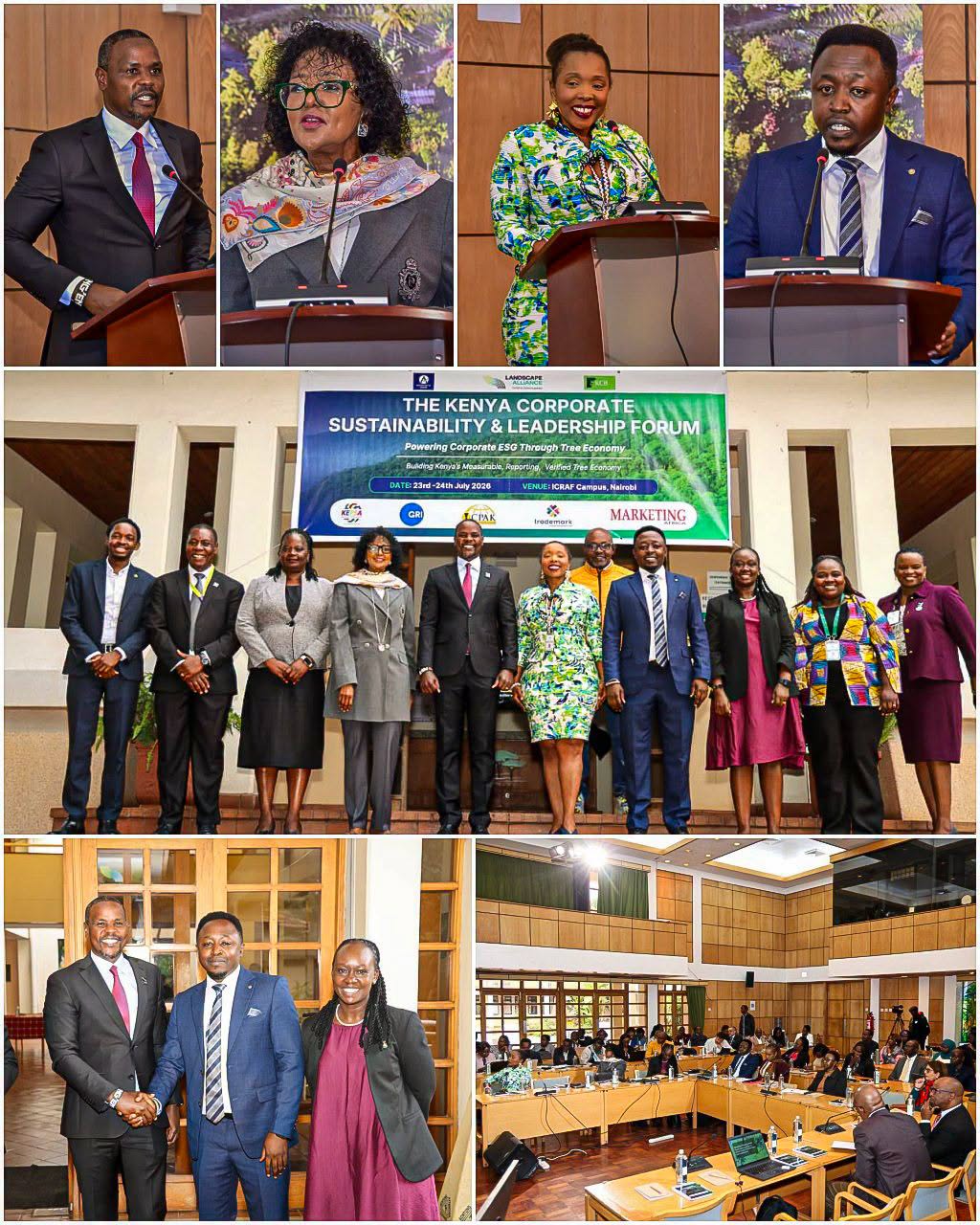
- KEPSA joined the launch of the Kenya Tree Economy Initiative to mobilise corporate investment in ESG, nature restoration and green growth.
- The initiative unveiled a Tree Economy and ESG Investment Platform and a charter to promote collaboration on sustainability, carbon markets and biodiversity conservation.
- Partners said KETEI will support Kenya’s 15 Billion Tree Growing Programme while expanding opportunities in climate finance, green jobs and sustainable value chains.
Kenya Private Sector Alliance (KEPSA) has joined the ALIVE Foundation, Landscape Alliance (CIFOR-ICRAF) and KCB Group as a founding institution behind the newly launched Kenya Tree Economy Initiative (KETEI), a platform aimed at mobilising corporate investment in nature restoration and green growth.
The initiative was unveiled on July 23-24, 2026, at the CIFOR-ICRAF Campus in Nairobi during the launch of the Kenya Corporate Sustainability and Leadership Forum, held under the theme “Powering Corporate ESG through the Tree Economy.”
A key outcome of the two-day event was the official launch of the Kenya Tree Economy and ESG Investment Platform and the adoption of the Nairobi Tree Economy Alignment Statement and the KETEI Co-Creation Charter.
The charter sets out a non-binding framework for joint action, peer learning and innovation among the founding partners, covering credible Environmental, Social and Governance (ESG) reporting, nature-positive investment, carbon markets, biodiversity conservation and sustainable landscape restoration.
The forum brought together senior government officials, private sector leaders, financial institutions, development partners, researchers and civil society representatives to discuss how businesses can accelerate Kenya’s shift towards a nature-positive, climate-resilient economy.
Dr Jackson Koimbori, Head of KEPSA Consult and Senior Circular Economy and Climate Change Coordinator, delivered opening remarks on behalf of KEPSA and later took part in a Leadership Insights panel discussion.
In his remarks, Dr Koimbori reaffirmed KEPSA’s commitment to helping businesses move from traditional Corporate Social Responsibility (CSR) towards strategic ESG integration.
He pointed to the organisation’s ongoing work in ESG capacity building, the circular economy, carbon markets, sustainable finance and climate resilience, as well as its role in developing Kenya’s National Circular Economy Strategy and Implementation Plan.
ALSO READ:
EBC warns Kenya’s Ksh995.7B domestic borrowing plan could tighten credit for small businesses
He said KEPSA had supported the government in advancing the National Green Jobs and Green Skills Programme, which is designed to equip the workforce with skills needed for the green economy.
He also cited KEPSA’s Carbon Market Guidebook for Kenyan Enterprises, developed to help businesses understand and participate in carbon markets and welcomed the operationalisation of Kenya’s National Carbon Registry by the National Environment Management Authority (NEMA), which he said would strengthen market transparency and unlock climate finance opportunities for the private sector.
Amb. Amina Mohamed, Patron of the ALIVE Foundation, urged the private sector to move beyond CSR and embrace ESG as a driver of sustainable economic transformation. She described KETEI as a flagship initiative pioneered by the ALIVE Foundation to mobilise corporate leadership and investment towards nature restoration, sustainable landscapes and inclusive green growth.
Delivering the keynote address, Dr Eng. Festus Ng’eno, Principal Secretary for Environment and Climate Change, said ESG should be viewed as a strategic opportunity rather than a compliance burden, one that allows businesses to create long-term value, attract sustainable investment and strengthen competitiveness through partnerships between government, science and the private sector.
During the panel discussion, Dr Koimbori said ESG had evolved beyond a reporting requirement into a strategic tool for managing risk, attracting investment and building resilient enterprises. He described the Tree Economy as an economic model extending beyond tree planting to strengthen water security, protect biodiversity, enhance supply chain resilience and unlock carbon and nature finance.
He urged businesses to prepare for emerging sustainability frameworks, including the International Sustainability Standards Board (ISSB), the Global Reporting Initiative (GRI), Integrated Reporting (IR) and the Taskforce on Nature-related Financial Disclosures (TNFD), which are increasingly shaping investor expectations and corporate governance.
By Benedict Aoya
Get more stories from our website: Sacco Review.
For comments and clarifications, write to: Saccoreview@
Kindly follow us via our social media pages on Facebook: Sacco Review Newspaper for timely updates
Stay ahead of the pack! Grab the latest Sacco Review newspaper!