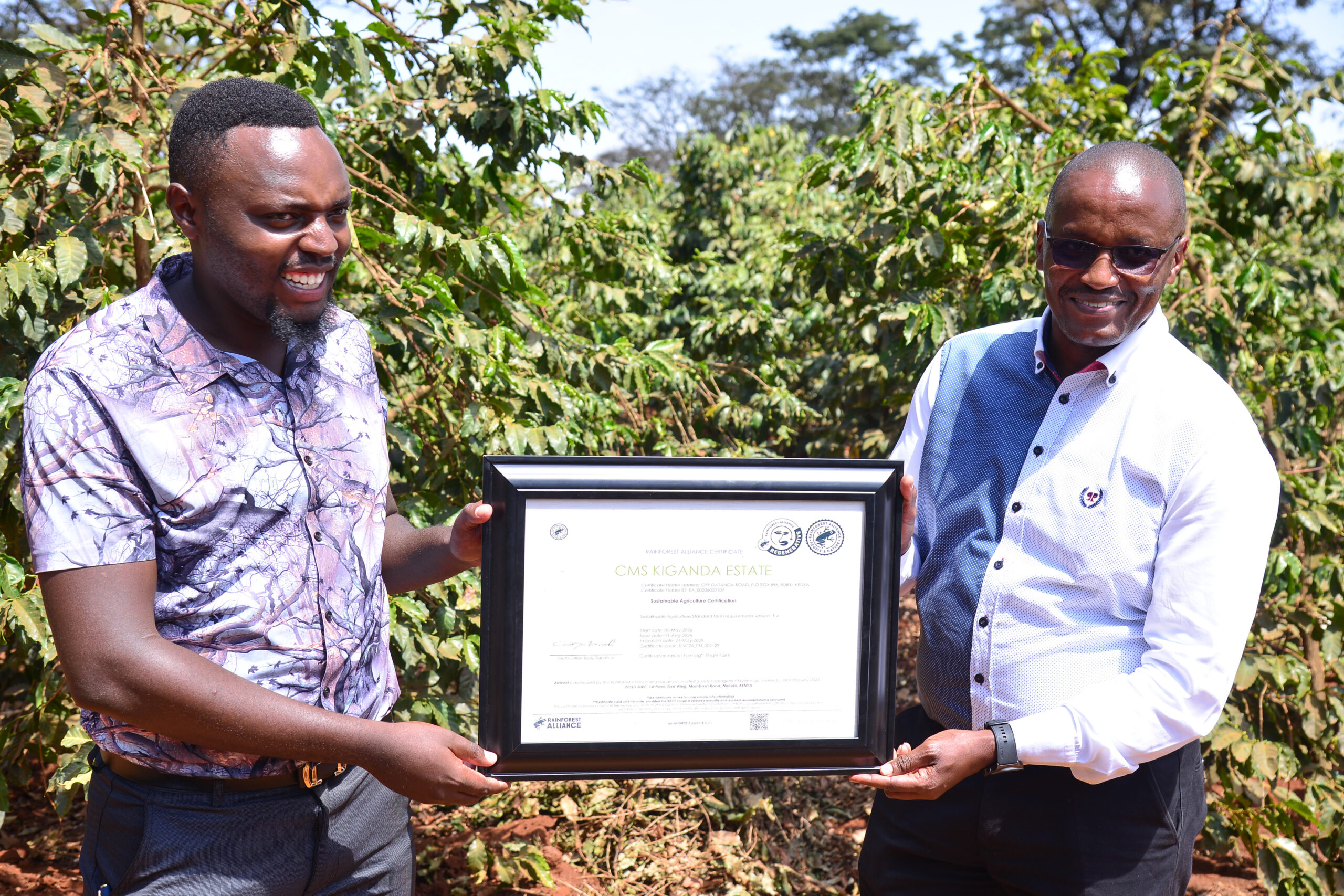
- Kiganda Estate has secured Africa’s first Rainforest Alliance regenerative agriculture certification.
- The farm is using new practices to improve soil health, conserve water and manage pests.
- The certification could open new markets and strengthen returns for the estate.
Kiganda Estate in Thika, Kiambu County, has become the first farm in Africa certified under the Rainforest Alliance Regenerative Agriculture Standard, a milestone the industry hopes will guide Kenya’s wider coffee sector.
The certification arrives as Kenyan coffee farmers face mounting pressure. Erratic rainfall, rising temperatures, worsening soil health and pests spreading into new areas are threatening both current yields and the industry’s long-term future.
Regenerative agriculture, a farming approach centred on restoring soil health and using natural resources more efficiently, has emerged as one response.
Kiganda’s certification followed a collaboration between the Rainforest Alliance, Coffee Management Services (CMS), the estate and other sector partners.
Farm Manager Paul Kabubi described the achievement as the result of years spent refining farming practices. He urged other farmers to treat regenerative methods as a standard way of farming, not an isolated project.
READ ALSO:
CMS, which leases and manages the estate, has produced coffee there for close to a century and employs nearly 200 workers. The company expects the certification to open new marketing opportunities while supporting better conditions for staff.
Steadier yields, smarter resource use
Martin Ngare, CMS’s Group General Manager, said the biggest promise of regenerative farming lies in evening out coffee’s naturally uneven yields, where a bumper harvest typically gives way to a lean one. Kiganda produces 110 to 120 tonnes of green coffee annually, and the estate aims to flatten those swings into a steadier pattern each season.
The farm pairs carefully calculated inorganic fertiliser, guided by soil testing, with organic inputs, including roughly 85 tonnes of manure applied over the past year. Nitrogen-fixing shade trees such as Albizia help build soil fertility, while pruned branches decompose on site and mulching helps retain moisture.
Ngare said the approach is already showing results, with output expected to hold steady after a harvest of around 120 tonnes rather than dip sharply, as it traditionally would. Steady supply matters to Kiganda’s international buyers, as the estate exports about six containers of coffee a year to Europe and the United States.
Water management has also shifted. The farm has moved from overhead irrigation, which lost significant volumes to evaporation in temperatures reaching 33 to 35 degrees Celsius, to ring basins around each tree that retain moisture more effectively.
On pest control, Kiganda now relies primarily on integrated pest management instead of routine chemical spraying.
Regular scouting allows workers to catch problems early, using cultural, mechanical and biological controls, including natural predators like wasps and ladybirds, before chemical treatment becomes necessary, and even then only on affected trees.
Ngare argued the practices support both better coffee quality and stronger returns, since certified coffee tends to command a premium. However, he cautioned that certification marks the start of an ongoing process rather than an endpoint.
By Benedict Aoya
Get more stories from our website: Sacco Review.
For comments and clarifications, write to: Saccoreview@
Kindly follow us via our social media pages on Facebook: Sacco Review Newspaper for timely updates
Stay ahead of the pack! Grab the latest Sacco Review newspaper!