- President Ruto signs tax laws extending reduced VAT on fuel and changing levies on selected building materials.
- The legislation maintains an 8 per cent VAT rate on petrol, diesel and paraffin for an initial 90 days.
- Kenya Revenue Authority board changes aim to strengthen coordination in tax collection and customs operations.
Kenyans will keep paying a reduced Value Added Tax (VAT) rate on fuel for the next three months, following President William Ruto’s assent to two tax laws on Friday, October 16, 2026. Beyond fuel, the laws also adjust levies on selected building materials and reshape the board of the Kenya Revenue Authority (KRA).
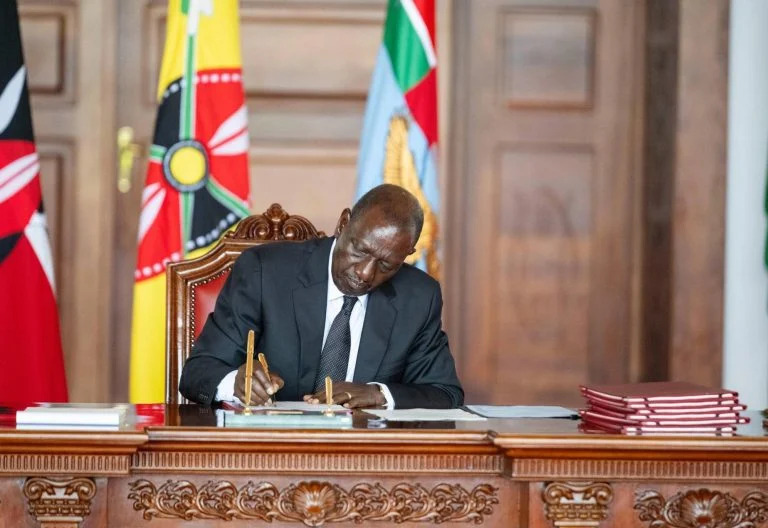
At Eldoret State Lodge, Ruto signed the VAT Amendment Bill and the Kenya Revenue Authority (Amendment) Bill. Before he gave his assent, Deputy Chief of Staff Josephat Nanok briefed him on both pieces of legislation.
Under the VAT law, an 8 per cent tax rate will continue to apply to petrol, diesel and paraffin for an initial 90 days. Another 90 days can be added if the situation in the Middle East fails to improve. From midnight on October 14, 2026, the law is deemed to have taken effect.
At half the standard 16 per cent VAT rate, the fuel tax is considerably lower than usual. Its purpose is to shield Kenyans from global oil market shocks that could drive up transport costs, production expenses and household bills.
During the briefing, an official said the reduced rate was already counted by the Energy and Petroleum Regulatory Authority (EPRA) when it announced the latest fuel prices. Pump prices, he explained, would have been higher without it.
READ ALSO:
Even so, cheaper fuel is not guaranteed by the lower rate. International crude prices, exchange rates and distribution costs also shape what motorists pay at the pump. Still, for drivers and businesses that burn plenty of fuel, the tax portion of their bills could at least be kept in check for now.
Building costs are also affected by the same law. Instead of the earlier weight-based system, tax on tiles will now be charged at Ksh 400 per square metre. Levies on ceramic fittings such as sinks will fall from Ksh 50 to Ksh 30 per kilogramme. Glass made locally will, in addition, be treated the same as float glass imported from East African countries, a move meant to support local industry and construction.
Developers and families putting up homes could see some costs drop as a result. However, how much buyers will actually save remains unclear. Final prices are influenced by manufacturers, importers, distributors and retailers, so households will only feel the benefit if it reaches the market.
Meanwhile, the composition of the KRA board is changed by the second law. Joining the board will be the managing director of the Kenya Ports Authority (KPA), a reflection of the close link between port operations, customs and revenue collection. As substantive members, the Attorney General, the Principal Secretary for the National Treasury and the KRA Commissioner General will also serve.
Better coordination and decision making among government bodies that handle revenue is the aim of these changes. Yet a new board line-up does not, on its own, guarantee higher collections or a more efficient tax system. How well the institutions work together once the law is applied will determine the results.
By Benedict Aoya
Get more stories from our website: Sacco Review.
For comments and clarifications, write to: Saccoreview@
Kindly follow us via our social media pages on Facebook: Sacco Review Newspaper for timely updates
Stay ahead of the pack! Grab the latest Sacco Review newspaper!