
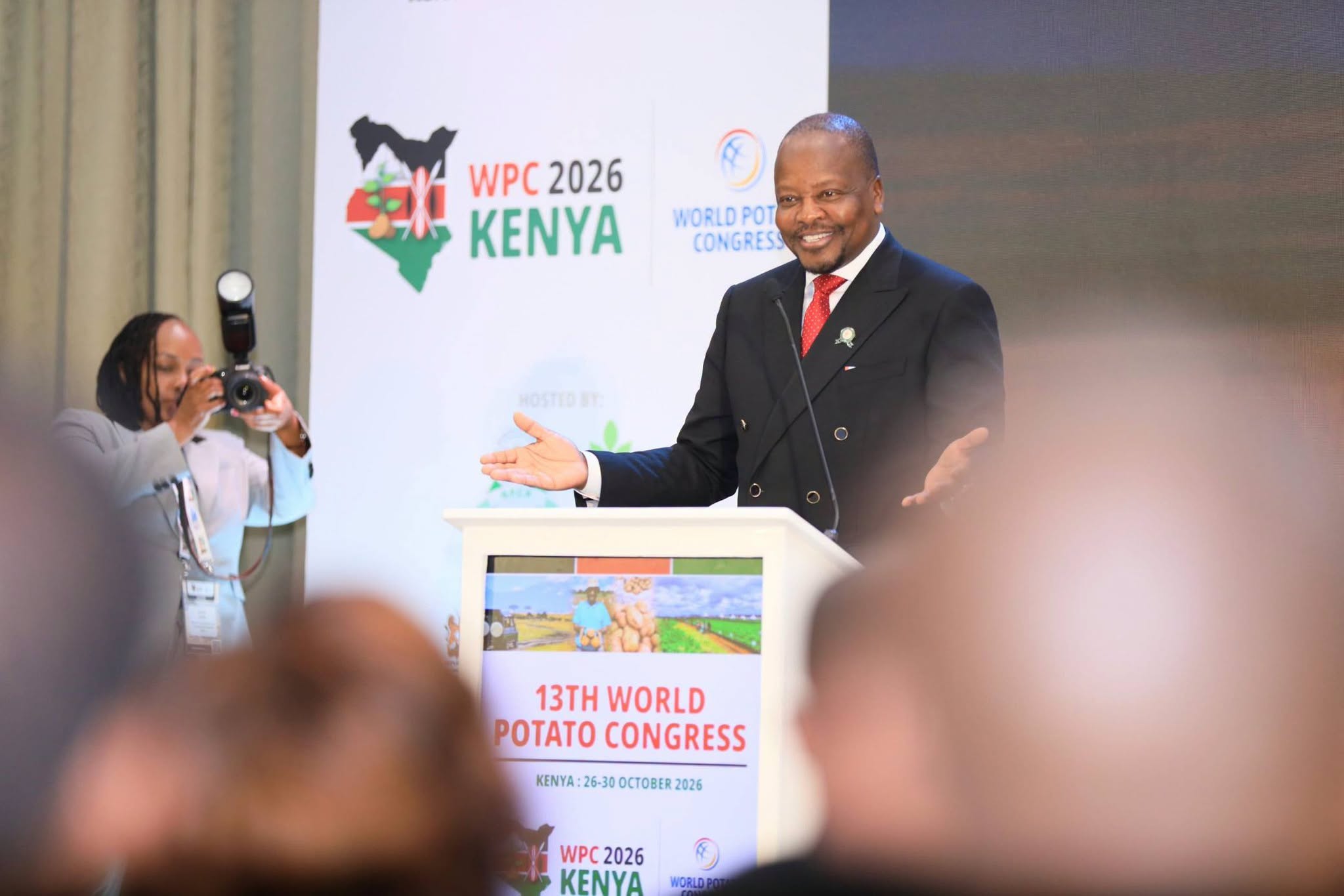
- Kenya is seeking investment to expand potato production and reduce reliance on imported potato products.
- Researchers are advancing disease-resistant varieties as the government targets higher yields and improved seed quality.
- The international congress is bringing together industry players to explore opportunities in processing, storage and trade.
Kenya is hosting the World Potato Congress for the first time in Sub-Saharan Africa, with 1,000 delegates from 67 countries in attendance.
The turnout far exceeds the organisers’ target of 600 delegates from 60 countries. The 13th edition runs from October 26 to 30, 2026, and gives Kenya a stage to seek partnerships in research, seed production, mechanisation, storage and processing.
Opening the event, Agriculture Cabinet Secretary Mutahi Kagwe asked investors to help Kenya cut its reliance on imported potato products. Local growers currently meet only 40 per cent of market demand, he said, while imports supply the remaining 60 per cent. He described that shortfall as a ready opening for farmers and processors, particularly those who can supply hotels, restaurants and fast food outlets, and argued that keeping that money at home would create jobs and build export capacity.
“This is an opportunity to substitute imports,” Kagwe said.
He urged delegates to make sure the gathering delivers practical benefits, with farmers’ incomes, productivity and access to markets at the centre of the talks.
“A food secure, healthier, prosperous farmer is also, in my considered view, a prerequisite for a safer, stable and productive society,” Kagwe said.
Kagwe also pitched the government’s Land Commercialisation Initiative, under which idle public land is leased to private investors for farming over long periods. He tied the offer to planned water infrastructure, including 50 mega dams, 200 medium dams and 1,000 water pans and reservoirs, meant to shield production from erratic rainfall.
READ ALSO:
Potato is Kenya’s second most important food and cash crop, he noted, sustaining jobs in farming, transport, trade and processing. Citing the Kenya National Bureau of Statistics, he said output reached about 2.2 million tonnes in 2024, worth Ksh72.5 billion. That was down from roughly 2.3 million tonnes the previous year, a fall linked to failed short rains and heavy long rains that fuelled fungal diseases such as potato blight.
To protect yields, the ministry is backing work on seed quality and disease control. Scientists at the Kenya Agricultural and Livestock Research Organisation (KALRO) and the International Potato Center have developed a biotech version of the popular Shangi variety carrying three resistance genes. Kagwe said it showed complete resistance to late blight in field trials, which could mean far less fungicide spraying. A second variety, Clone IG-70, bred at the KALRO centre in Tigoni to tolerate drought and blight, is nearing final verification.
Farmers also stand to gain from a new KALRO potato sub-centre at Marindas in Kuresoi North, Nakuru County, opened three months ago to widen access to certified seed and training. Separately, the Kenya Sustainable Potato Initiative, run with Egerton University and the National Potato Council of Kenya, aims to support 150,000 growers. Kagwe stressed that such gains depend on strict inspection and certification by the Kenya Plant Health Inspectorate Service (Kephis), along with firm action against counterfeit seed.
Cold storage facilities built in 12 counties over the past four years are meant to curb losses and open routes to market. At a preparatory meeting last week, Kagwe also said he was ready to approach the National Treasury about zero rating potato processing machinery, and asked industry players to submit lists of the equipment they need.
The congress, themed “Global Potato Partnership for Enhanced Food Systems, Nutrition Security, and Trade,” includes a Farmer Field Day, a Women in Potato initiative and a Teens Programme under the 4K Club.
By Benedict Aoya
Get more stories from our website: Sacco Review.
For comments and clarifications, write to: Saccoreview@
Kindly follow us via our social media pages on Facebook: Sacco Review Newspaper for timely updates
Stay ahead of the pack! Grab the latest Sacco Review newspaper!