- WEF wants more government funding as demand for women’s SME loans rises.
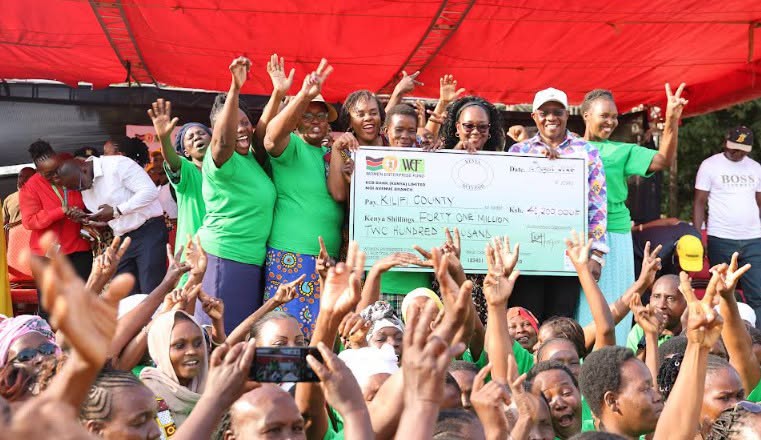
- Ksh 41.2 million was disbursed to 200 women’s groups in Kilifi.
- WEF cut its maximum loan limit from Sh1 million to Ksh750,000 due to rising demand.
Women Enterprise Fund (WEF) is pushing for a bigger government allocation after seeing a sharp rise in applications from women’s groups seeking affordable financing to start or grow small and medium enterprises.
WEF CEO Rachael Musyoki said the fund is fielding a growing volume of applications from women’s groups, with many existing beneficiaries also asking for higher loan ceilings to expand their businesses.
She spoke during the disbursement of cheques worth Ksh41.2 million to 200 women’s groups in Kilifi County, funding she said would reach more than 1,800 women and help strengthen their businesses and household incomes.
Musyoki said WEF had done much to lift household incomes, but constrained resources meant it kept recycling the same pool of funds even as demand from women kept climbing.
“The money we are given as WEF is not enough and therefore as we support the President’s agenda of women empowerment, it is my prayer that we get more money to reach out to more grassroots women and this can only be done through our Members of Parliament,” she said.
IN CASE YOU MISSED IT:
She praised women in Kilifi for keeping loan repayment above 88 per cent overall, arguing that a bigger budget allocation would let WEF match the rising appetite for larger loans.
Several groups had qualified for loans of up to Ksh1 million, she noted, but limited resources meant the fund could not always pay out in full.
“For business to grow and succeed, there must be access to affordable financing, relevant training and reliable support systems. WEF remains committed to ensuring that women across the country, including here in Kilifi, are fully supported to participate in economic activities,” she said.
WEF Director Yvonne Tonkei backed the call for more funding, explaining that the agency had cut its maximum loan limit from Ksh1 million to Ksh750,000 as applicant numbers grew.
“We initially had a limit of up to Sh1 million but we had to revise the limit to Sh750,000 because the fund could not sustain the number of applicants and that is why we are appealing to Members of Parliament to help us push for more funding,” she said.
Musyoki also encouraged grassroots leaders to help women form viable groups and tap into government programmes, saying pooled borrowing and investment can build lasting income streams and stronger households.
For its part, the Kilifi County Government reaffirmed its commitment to women’s economic empowerment, pointing to initiatives such as the Wezesha Fund, which offers financial support to women and other groups at county level.
READ ALSO:
Kilifi Deputy Governor Florah Mbetsa Chibule said empowering women is central to sustainable economic growth, given their outsized role in the economy.
“Women in Kenya make up more than half of all the small and micro-enterprise operators. Women produce more than 60 per cent of food. An economy that excludes half of its workforce from full participation cannot achieve its potential,” she said.
Beneficiaries described the impact of the funding firsthand. Christine Machuka, chairperson of one of the beneficiary groups, said WEF financing had allowed members to set up a table-banking scheme that funnelled investment into various ventures, from small retail shops to beaded shoes and baskets.
Some beneficiaries, however, flagged inconsistencies in the requirements for certifying and renewing their groups’ certificates, describing the process as frustrating at times. They called for clearer, more consistent rules to ease access to empowerment programmes going forward.
By Bernard Magada
Get more stories from our website: Sacco Review.
For comments and clarifications, write to: Saccoreview@
Kindly follow us via our social media pages on Facebook: Sacco Review Newspaper for timely updates
Stay ahead of the pack! Grab the latest Sacco Review newspaper!