
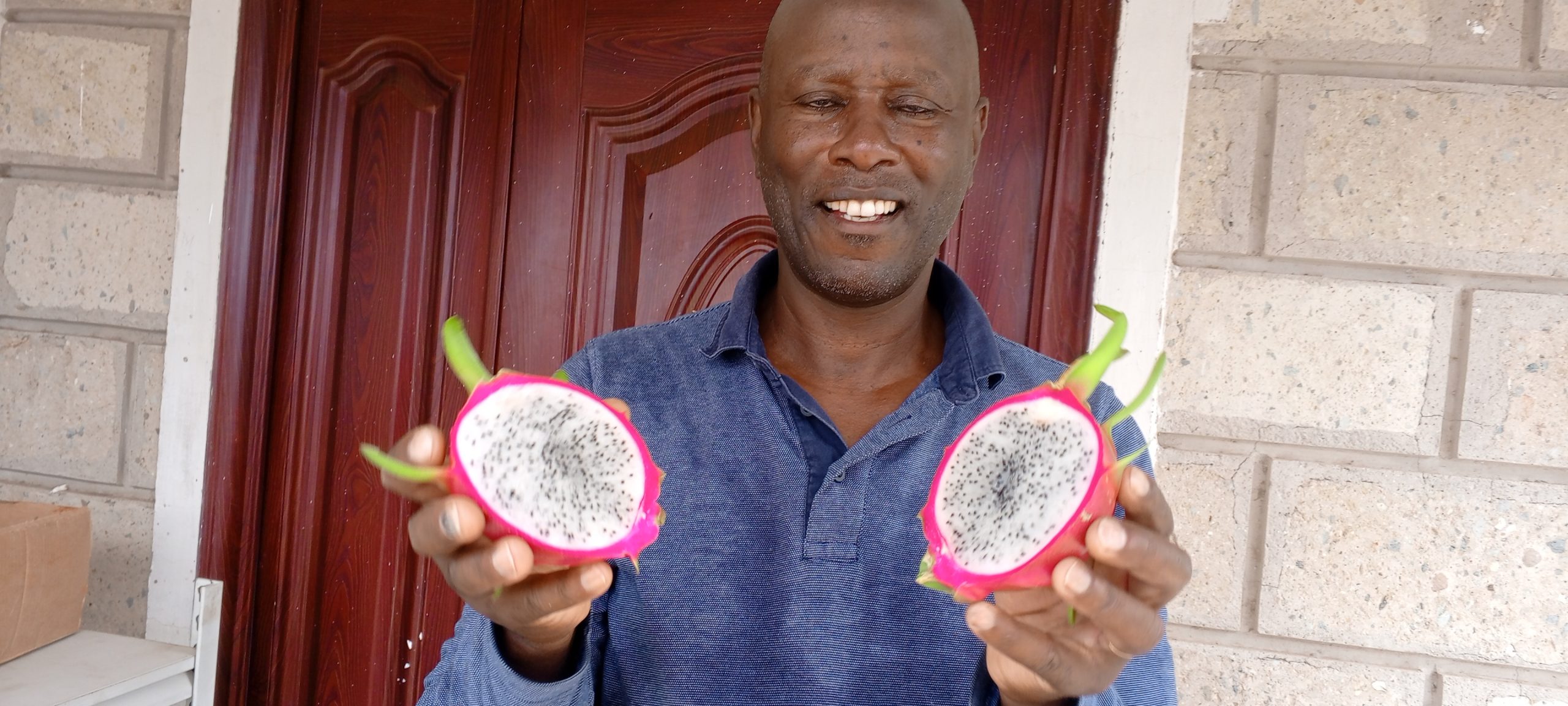
- Meru farmer turns a rocky landscape into a thriving dragon fruit farm
- Mugambi develops a patented dragon fruit variety after years of research
- Farmer urges Kenyans to embrace dragon fruit farming as demand rises
Antony Kinoti Mugambi, Africa’s pioneer dragon fruit farmer, has become the talk of the town after deliberately and resiliently transforming a remote, hilly, rocky and dusty location in Meru County into an oasis of hope within a span of a few years.
Mugambi has turned a once semi-arid and sleepy location in Mwangathia ward, Central Imenti constituency, into a thriving farmland composed of several fruit trees with economic, nutritional and medicinal value to residents and visitors who frequent his homestead in search of the rare and expensive dragon fruit.
Despite a single dragon fruit selling at a minimum of Ksh1,000, Mugambi’s homestead has turned into a destination of choice for many dignitaries from Kenya and abroad seeking the fruit’s benefits, with most looking for its medicinal value.
The farmer says that despite his hard work, including buying expansive land, ensuring a steady water supply, employing an adequate labour force and involving residents in his project, he is yet to meet the fruit’s high demand. He is now urging other Kenyans, especially youth in remote areas where it thrives well, to embrace the idea, citing its unprecedented economic benefits.
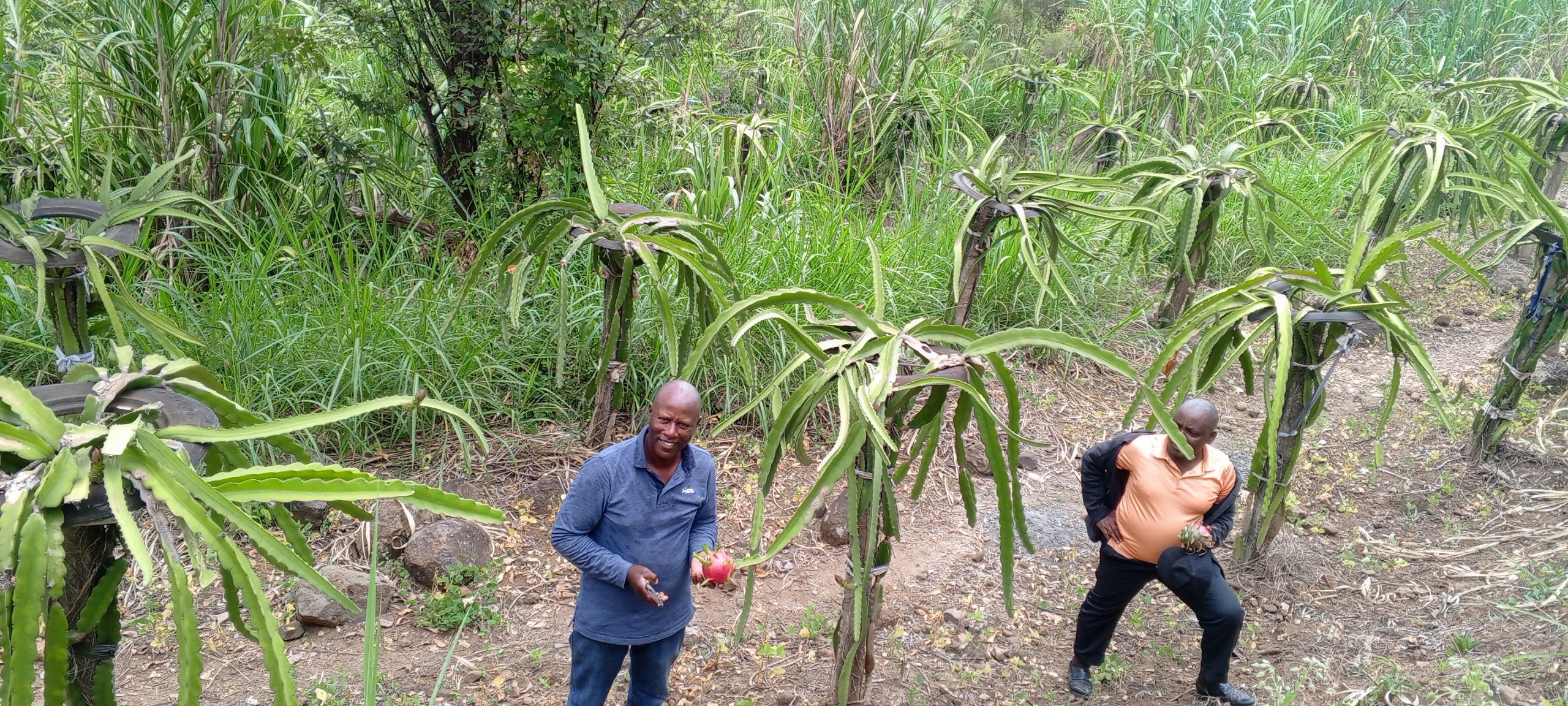
Mugambi is a telecommunications engineer working in Nairobi. He discovered the fruit during a work trip to China in 2012, when he visited a friend who took him to an eatery where dragon fruit was on the menu and ready to be served. At the time, he had no idea the visit would help him build his own multi-millionaire-shilling dragon fruit farm.
“Twenty-three years ago, I visited Guangzhou, China, and ate a very interesting food item. I didn’t know if it was a plant, fruit, vegetable or a processed item. It was melting in my mouth like ice cream,” he said.
For a record nine years, the taste stayed in his mind until his second visit to the country. “I observed Chinese people were looking healthy and active. You could hardly differentiate the old from the young,” he narrated.
His friend, a Chinese national named Alex Sundebao, told him the secret was simply that they ate food as medicine, introducing him to Pak Choi, durian, mangosteen and dragon fruit.
“The name dragon fruit caught my attention and made me curious because a dragon is a mythical creature. But he insisted it was a valuable fruit,” said the engineer.
ALSO READ:
Later, at a supermarket, Sundebao picked an artificial-looking item, similar to a pineapple but soft, that cost about 10 US dollars. That is when it dawned on Mugambi that it was the same dragon fruit he had eaten earlier.
He then brought seeds extracted from the fruit back home, planted them and waited patiently for eight years. On April 28, 2020, he got his first fruit.
Dragon fruit, part of the cactus family, originated in South America, where it is known as pitaya. Mugambi discovered that one can cross the wild cactus variety with dragon fruit to create a new variety.
He developed his own variety, which took four years to receive government patent protection valid for 25 years. Under the law, plant breeder rights protect the developer from any other entity benefiting from the intellectual property without consent or authorisation.
As Kenya’s pioneer dragon fruit farmer, Mugambi had no one to learn from. “For instance, some varieties are self-infertile. You have to wake up at night, get pollen from another flower and pollinate them. It also flowers only one night in its entire existence,” he said.
He added that the seed takes eight to ten years to produce a fruit, while mature stems, which he has now produced in large numbers, take between 12 and 18 months.
Mugambi has urged farmers to diversify instead of relying on traditional cash crops, noting that semi-arid areas are well suited to the crop since it takes less time to mature in warm areas than in cold ones.
After harvesting his first batch of fruits, he expanded his orchard and nursery, though demand still outstrips supply. He has since mentored over 1,000 farmers across Africa. His first international guest was Emmanuel Okine from Ghana, who visited in 2021 and now runs a successful orchard back home.
The fruit remains expensive due to its health benefits, nutritional value, and use in pharmaceuticals and cosmetics. In Kenya, a kilogram costs about Ksh1,500.
Mugambi says the fruit also helps reduce hyperacidity or stomach acidity. “For instance, if you consume pepper and then chew dragon fruit, the pepper’s bitterness goes away within two minutes,” he said.
On managing pests, he explained that fruit flies damage dragon fruit by laying eggs inside it, which then develop into larvae. “We mitigate this by minimising the use of chemical pesticides. We recommend fruit fly traps — pheromone-laced pesticide placed in a container — which attract the flies, trap them, and they die inside,” Mugambi said
By John Majau
Get more stories from our website: Sacco Review.
For comments and clarifications, write to: Saccoreview@
Kindly follow us via our social media pages on Facebook: Sacco Review Newspaper for timely updates
Stay ahead of the pack! Grab the latest Sacco Review newspaper!