
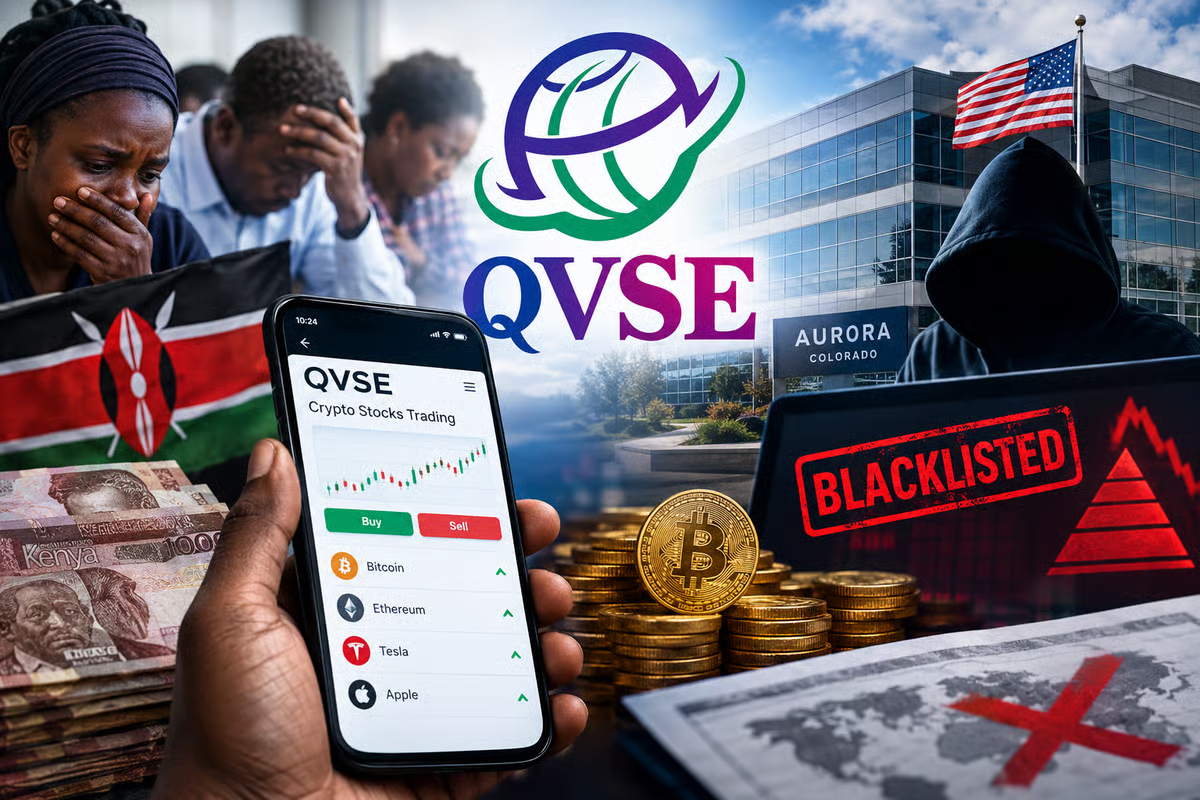
- QVSE attracted investors with promises of quick returns from US stocks
- Account freezes left investors unable to access displayed balances
- CMA warning raises questions about the platform and similar schemes
For many Kenyans, especially teachers, small traders and other middle-income earners, QVSE appeared to offer a simple route into the lucrative world of US stocks.
Put in about Ksh65,000, follow trading signals from a man known as “Prof Carl” and watch the dollars supposedly pile up. At one point, the numbers on the screen could make the whole thing look almost too good to be true.
And then came the part nobody puts in the investment brochure: you could see your money, but you could not get it out.
QVSE was presented to investors as an online trading platform where users could supposedly trade shares of companies such as Tesla and Apple by following signals sent through the BonChat app. Investors were required to deposit at least $500, about Ksh65,000.
According to Business Daily, investors with $500 were told they could make about $6, or Ksh777, from each trade, while those with $1,000 could earn about Ksh1,553. With two trading sessions a day, the figures made the returns look particularly attractive.
The platform also relied on referrals. Existing investors were encouraged to bring in friends, relatives and colleagues, helping the operation spread through personal networks.
Then, in early September, the mood changed.
QVSE froze investors’ accounts, alleging that some users had created multiple accounts to increase their trading limits. Investors were subsequently told to deposit another Ksh65,000 or Ksh129,000 to verify and unlock their accounts.
READ:
That was the point where the investment equation took an interesting turn: you had put money in to make money, and now you needed to put in more money to get your money back.
The Capital Markets Authority (CMA) subsequently warned that QVSE was not licensed to operate in Kenya and listed it among 15 entities it said were unlawfully soliciting funds from the public. The regulator said the entities were under investigation by the Directorate of Criminal Investigations (DCI), CMA and other law enforcement agencies.
But QVSE was not the first scheme associated with “Prof Carl”.
In 2025, a similar operation known as PCEX, operating under the Global Investment Group banner, attracted Kenyan investors using a comparable copy trading model. Investors deposited $500 and received trading signals through Telegram. PCEX later announced a temporary closure in April 2025 and told investors their money would become accessible in January 2026. It did not reopen as promised.
Reporting by Business Daily also found that the same name and photograph associated with “Prof Carl” appeared in the PCEX and QVSE operations. A reverse image search traced the photograph to a Norwegian photographer’s portfolio, where it had been uploaded in 2021.
The scale of QVSE’s Kenyan reach remains unclear. One WhatsApp group administrator claimed the group had 12,005 Kenyan investors. Business Daily noted that it could not independently verify that membership figure, individual deposits or the total amount collected.
Some investors reportedly had balances running into hundreds of thousands or even millions of shillings displayed on their accounts, only to find themselves unable to withdraw the money.
That is perhaps the most important part of the QVSE story. A balance appearing on an app is not necessarily money safely sitting in your bank account. If withdrawing your own money suddenly requires another deposit, that is not the moment to reach deeper into your pocket. It is the moment to start asking very uncomfortable questions.
For Kenyans considering online investments, the CMA’s warning offers a basic but important checkpoint: verify that the company is licensed by the relevant regulator before sending money.
By Khayoyo Ian
Get more stories from our website: Sacco Review.
For comments and clarifications, write to: Saccoreview@
Kindly follow us via our social media pages on Facebook: Sacco Review Newspaper for timely updates
Stay ahead of the pack! Grab the latest Sacco Review newspaper!