
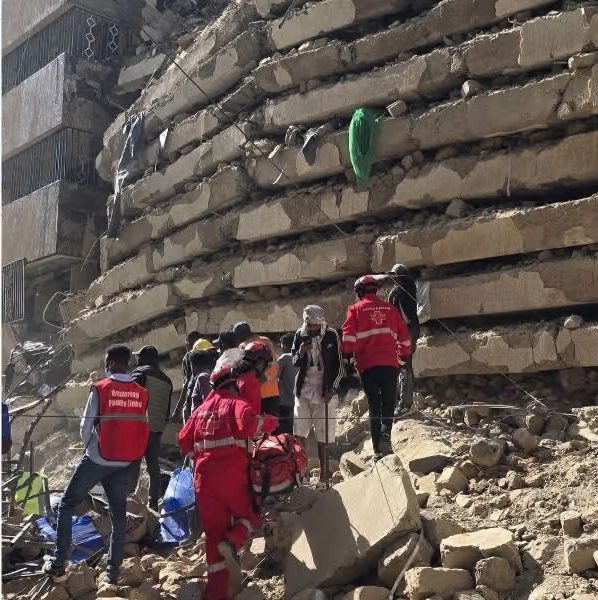
- Fresh building collapses expose persistent weaknesses in Kenya’s construction safety enforcement
- Inspection findings raise questions over thousands of unsafe and non-compliant buildings
- Calls grow for nationwide safety audits and accountability for construction failures
Kenya is increasingly facing a disturbing construction safety crisis in which buildings that should provide shelter, security, business opportunities and comfortable working environments are turning into potential death traps. The latest collapse of an eight-storey building in Syokimau, Machakos County, has once again exposed serious weaknesses in construction supervision, structural engineering, regulatory enforcement and professional accountability.
The tragedy occurred on Friday, November 13, 2026, barely three weeks after another devastating building collapse in Nairobi’s Eastleigh area on October 23, 2026, which claimed eight lives.
The Syokimau disaster left six people dead and five others rescued and taken to hospital. Initial reports indicated that the structure collapsed during concreting work on an upper floor, raising questions about the stability of temporary structures supporting wet concrete and the quality of construction supervision.
The two tragedies have renewed public concern about whether Kenyans can confidently occupy residential apartments, conduct business in commercial buildings or work on construction sites without fearing that the structures above them could suddenly give way.
The question is no longer simply why buildings collapse. It is why repeated disasters have failed to produce sufficient deterrence, accountability and lasting improvements in construction safety.
Building collapses are not a new phenomenon in Kenya. Research published in the Journal of the Kenya National Commission for UNESCO documented collapses in every year between 2011 and 2020, peaking at about 21 in both 2015 and 2016. The year 2016 stands out because of the 78 fatalities reported, the highest in that period.
More recent government records reported 12 collapses in 2021, 13 in 2022, 12 in 2023, four in 2024 and four in 2025.
A separate compilation drawn from media reports identified at least 84 building collapses between January 2020 and November 13, 2026, resulting in at least 102 deaths and 138 injuries. Nairobi accounted for 31 incidents in that compilation, followed by Kiambu with 13, and 25 collapses had already been recorded in 2026 by mid-November.
These datasets use different reporting methods and should not be combined into one continuous statistical series. Nevertheless, they demonstrate that building safety remains a persistent national challenge.
One of the darkest chapters in Kenya’s construction history occurred on April 29, 2016, when a six-storey building collapsed in Huruma, Nairobi, following heavy rainfall. The disaster claimed 51 lives and left many families devastated.
READ ALSO:
In September 2019, another tragedy occurred at Precious Talent Academy in Dagoretti, Nairobi, when a classroom block collapsed, killing eight pupils and injuring others. It raised serious questions about the safety of school infrastructure, the responsibility of school proprietors and the effectiveness of inspections.
The Eastleigh and Syokimau disasters have now shown that the problem has not disappeared. They should force the country to reconsider whether construction regulations are being implemented effectively or whether compliance is sometimes treated as a formality.
A building collapse is not merely a property accident. It is a human tragedy that destroys families, interrupts children’s education, eliminates livelihoods and exposes weaknesses in public administration.
Perhaps the most disturbing revelation about the country’s building safety situation comes from the 2018 assessment by the National Building Inspectorate. The exercise examined approximately 14,925 buildings and classified 723 of them as very dangerous.
Another 10,791 were found to be unsafe and in need of strengthening or demolition, while 1,217 were in fair condition and only 2,194 were considered safe. The overwhelming majority of the buildings assessed therefore had safety concerns requiring attention.
The country must answer a critical question about what happened to the buildings identified as dangerous or unsafe. How many were demolished? How many were strengthened? How many were evacuated, and how many continue to accommodate families, businesses and schools?
An updated national register would help Kenyans understand whether the recommendations of that inspection exercise were ever implemented.
The situation is equally worrying for new construction projects. A government quality assurance assessment covering July 1, 2025, to April 2, 2026, inspected 21,282 construction sites. It found that 12,018 sites were not compliant or had been suspended, while 9,264 met the required standards.
That translates into approximately 56.5 per cent of inspected sites falling short. Non compliance does not automatically mean that every affected building was structurally unsound, but the findings point to widespread weaknesses in adherence to construction regulations and raise serious questions about supervision, approval procedures, professional involvement and inspection.
It is particularly troubling that these findings emerged in a country that has repeatedly watched buildings collapse and claim innocent lives.
Investigations into previous failures have identified several recurring weaknesses. Poor structural designs remain a major concern, with some buildings designed without adequate consideration of the loads they must carry, the soil beneath them and the strength of the materials used.
Weak foundations compromise stability, particularly where developers skip geotechnical investigations before construction begins. Substandard materials, including poor quality concrete and insufficient reinforcement steel, weaken essential structural components, while incorrect concrete mixing, inadequate compaction and insufficient curing undermine the strength of a building.
Investigators have also raised concerns about unqualified individuals participating in construction projects, inadequate supervision by registered professionals and developers adding floors beyond approved plans.
Temporary structures such as scaffolding and formwork present another risk, since they must safely support wet concrete and construction loads until permanent elements can carry them. Where these systems fail, workers and other people within the building are exposed to catastrophic danger.
The January 2026 South C building collapse illustrates what happens when developers ignore approvals. An investigation reportedly found that four additional floors had been constructed beyond the approved design, even though the project had undergone earlier quality assurance inspections. That raises questions about how unauthorised construction could progress despite regulatory oversight.
IN CASE YOU MISSED IT:
The Engineers Board of Kenya also investigated collapses in Kirigiti, Kiambu County, and Ololua, Kajiado County, in 2022. Preliminary findings on the Kirigiti project indicated that it was not registered with the county government or the National Construction Authority (NCA) and that there was no evidence of professional engineering involvement in its design and supervision.
These cases show why regulators must verify what is actually happening at construction sites instead of relying exclusively on submitted documents.
One of the biggest misconceptions in the industry is that the contractor alone should shoulder responsibility whenever a building collapses. Responsibility must be established through investigation, and it may extend to several parties.
The developer must engage qualified professionals and ensure statutory compliance. Architects and structural engineers answer for their designs and the supervision assigned to them, while the contractor must execute the work according to approved plans and standards. County governments are responsible for development control and enforcement within their jurisdictions, and the NCA regulates contractors and compliance.
A contractor who knowingly uses substandard materials cannot escape responsibility by blaming the engineer. Equally, a professional who approves unsafe structural work cannot simply transfer the blame to the developer.
Kenya needs a coordinated national response that goes beyond temporary public outrage. Authorities should conduct a fresh nationwide structural safety audit covering residential apartments, commercial buildings, schools, hospitals and offices.
Buildings officially declared dangerous should be tracked until the recommended action is completed, and those that cannot be made safe should be evacuated and demolished in accordance with the law. County governments should strengthen inspections and immediately stop projects that violate approved plans, while professional supervision should be verifiable at every critical construction stage.
Developers, contractors and professionals found responsible for negligence should face disciplinary or criminal action. Kenya should also establish a publicly accessible building safety database showing approved projects, inspection records, compliance status and buildings condemned for occupation.
Investigations into major collapses should be published, with clear explanations of the causes, institutional failures and corrective measures. The government must further explain what happened to buildings identified as dangerous in earlier inspections, which developers have been prosecuted and which professionals or regulatory officials have faced accountability.
The crisis also carries a lesson for schools, colleges and universities. Mathematics, physics, engineering and vocational training are not merely academic subjects, because their practical application can determine whether a building stands safely for decades or collapses and kills innocent people.
Learners must understand professional ethics, honesty, competence and accountability. An engineer who approves an unsafe design, a contractor who compromises materials and an inspector who ignores violations can all contribute to consequences that extend far beyond the construction site.
Kenya cannot continue treating building collapses as isolated accidents that attract attention for a few days before normal activities resume. The country has conducted inspections, commissioned investigations and established regulatory institutions, yet the biggest challenge remains translating those findings into action.
Kenyans deserve to know who approves buildings, who inspects them, who supervises construction and who takes responsibility when structures fail. A building permit should be evidence of compliance, not a licence to compromise human life.
The best building inspection is one that prevents a disaster, not one that arrives after people have been buried beneath the rubble.
By Hillary Muhalya
Get more stories from our website: Sacco Review.
For comments and clarifications, write to: Saccoreview@
Kindly follow us via our social media pages on Facebook: Sacco Review Newspaper for timely updates
Stay ahead of the pack! Grab the latest Sacco Review newspaper!