
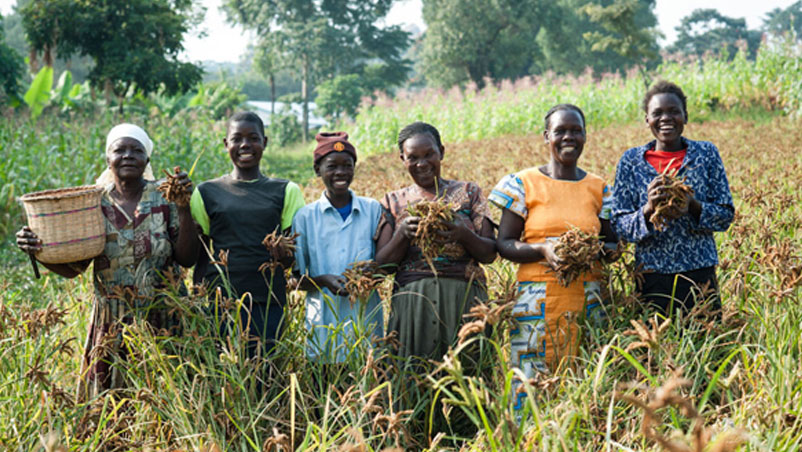
- Women smallholders earn more per hectare but their businesses generate lower profits.
- Limited machinery and access to affordable credit constrain women-led service centres.
- Thousands of farmer service centres face uncertainty as donor support winds down.
Women smallholders in Kenya earn about 18 per cent more from each hectare than men do, yet the Farmer Service Centres (FSCs) women run keep only Ksh28 in profit for every Ksh100 that male-led centres make. The gap emerges from a nine year evaluation by the Farm to Market Alliance (FtMA), which tracked a network that now spans 13 counties.
On the farm, the numbers favour women. Their main season revenue averages Ksh82,494 per hectare, against Ksh69,833 for men. A centre, however, is a business and not a plot of land. Women-led centres reported average annual profits of Ksh143,989, while male-led ones reported Ksh515,253. That leaves a difference of more than Ksh371,000 a year, and men earn about 3.6 times as much.
Women-led centres own an average of two pieces of machinery, compared with 3.2 at male-led centres. Machines let a centre sell services such as shelling, threshing and handling bulk produce, so every missing unit is income left on the table. A difference of 1.2 machines cannot by itself account for a profit gap this wide. My reading is that equipment reflects how these centres are financed more than it explains the shortfall.
Seven in every ten FSCs have no formal institutional credit, even though 97 per cent keep bank accounts. Almost every centre, in other words, has a door into the banking system, and most never get past it. The evaluation blames lending rules that ask for land as collateral, which pushes operators towards informal borrowing. That route supplies 20 per cent of centre financing. Informal credit tends to be short and expensive, and it rarely stretches to a machine that pays for itself over several seasons.
The report does not split the collateral problem by gender. In many rural households, though, land is registered in a man’s name. If that holds across the network, a woman who runs a successful centre may still lack the one asset a lender wants to see. That is an inference and not a finding, yet it would square with women who produce more per hectare ending up with the smaller balance sheet.
READ:
Inside Ruto’s State of the Nation address and Sh5 trillion plan
Only 8.5 per cent of centres across the network own shelling or threshing equipment. Where drying, shelling and bagging are done by hand, women may lose as much as half of their bean harvest. Such losses cut into the very advantage that gives women their lead on the farm. Revenue per hectare is measured at the point of sale, so it can look healthy even when a large share of the crop never makes it there.
About 89 per cent of farmers in the network sell what they grow, but only 3.8 per cent hold formal contracts with buyers and just 18.5 per cent are paid promptly. A centre that cannot count on a contract or a payment date has little to show a lender. Without contracts there is no predictable income, without predictable income there is no credit, and without credit there is no equipment to cut losses or win bigger buyers.
Even so, the model has delivered scale. Implemented by the Cereal Growers Association since 2017, the programme has grown from two counties to 13 and set up 2,126 centres that reach about 401,955 farmers. Together they have marketed 664,009 metric tonnes of produce. Certified seed adoption among surveyed farmers stands at 88 per cent, and farmers practising Conservation Agriculture lifted main season maize yields by 60 per cent, from 2.83 to 4.53 metric tonnes per hectare.
George Njoroge, the FtMA Kenya Country Coordinator, says women and young farmers connected to reliable inputs, training and structured markets “deliver the highest returns per acre in Kenyan agriculture.” The evaluation bears him out on the field. High yields, however, do not travel automatically to the enterprise that aggregates and sells the crop.
The network includes 1,015 youth run centres, which is nearly half of all centres, and each employs an average of 6.1 young people. That works out to roughly 6,200 jobs. Youth farmers averaged 3.6 metric tonnes of maize per hectare against 2.9 among older farmers, about 24 per cent more, and 91 per cent of them sold into structured markets. Their showing suggests that guaranteed buyers matter as much as skill or experience, and women are denied that advantage far too often.
READ:
The evaluation projects that about 70 per cent of centres could stay viable once programme support ends. Applied to 2,126 centres, that implies close to 640 could fail. Since women-led centres already run on thinner profits and fewer assets, they may well be overrepresented among them, although the report does not say so.
Bai Mankay Sankoh, the World Food Programme (WFP) Kenya Deputy Country Director, says the next phase should help “build viable rural enterprises that can continue serving farmers because doing so makes commercial sense,” and should not keep centres alive through donor funding. That is a sound goal, but it raises the stakes for women-led centres, which will have to prove commercial sense from the weakest financial footing in the network.
The report recommends asset financing aimed at women-led centres, supply chain credit that needs no collateral and leans on buyer contracts instead, and wider access to digital agricultural services. Each proposal targets a link in the loop of contracts, income, credit and equipment. If they are adopted, the profit gap could narrow. If they are not, the network’s most productive farmers will keep running its least profitable businesses.
By Benedict Aoya
Get more stories from our website: Sacco Review.
For comments and clarifications, write to: Saccoreview@
Kindly follow us via our social media pages on Facebook: Sacco Review Newspaper for timely updates
Stay ahead of the pack! Grab the latest Sacco Review newspaper!