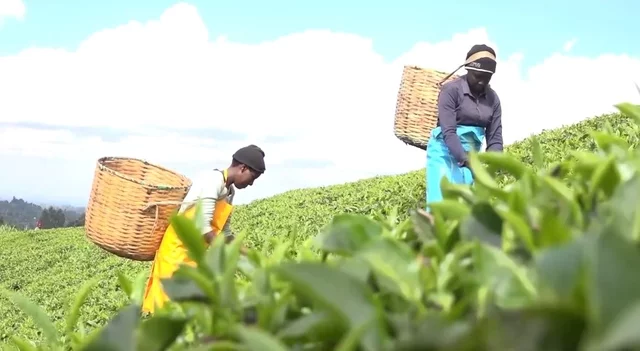

Small-scale tea farmers from Bomet County are threatening to stop supplying green leaf to the Kenya Tea Development Agency (KTDA), accusing the agency of economic exploitation and poor returns that have left them struggling to survive.
Led by Ndaraweta Parish Priest Father Ambrose Kimutai, the farmers have given the government one month to intervene and address what they describe as oppressive systems within KTDA that have eroded the livelihoods of smallholders.
They say unless President William Ruto’s administration acts to protect farmers; they will mobilize a boycott of KTDA factories and block key transport routes across the Rift Valley.
Speaking in Ndaraweta, Father Kimutai said he would begin mobilizing farmers in the leading tea-producing counties of Bomet, Kericho, and Nandi to demand fair treatment and transparency in tea pricing.
“KTDA was established by the government in 1964 to help Africans who were not allowed to grow tea. It is unfortunate that now, what was created to uplift small-scale farmers, has turned into an institution destroying them through multiple exploitative structures,” said Father Kimutai.
He accused KTDA of underpaying farmers despite rising production costs, saying the low bonuses paid out this year are shameful and unsustainable.
Faith Kimutai cited the high cost of production and inputs, such as fertilizer which now costs around Ksh 2,500 per bag, as leaving farmers with little or no profit.
“We wait for the bonus every year, but this time it is a tragedy. Here in Bomet, the bonus is only Ksh 13 per kilogramme. Thirteen shillings! Shame on you. Farmers are crying,” he said passionately, drawing applause from parishioners and farmers in attendance.
ALSO READ:
Meru, Embu, Tharaka Nithi counties join forces to turn waste into source of revenue
According to figures shared by the priest, this year’s bonuses for farmers in the West of Rift have dropped sharply compared to last year. Kericho farmers earned Ksh 245 per kilogramme, a drop of Ksh101; Bomet farmers received Sh 209, down Ksh 85; Nyamira earned Sh 266, down Ksh 106; Kisii earned Kh 246, down Ksh 95; and Nandi/Vihiga fetched Ksh208, a reduction of Ksh 66.
The priest questioned KTDA’s pricing policies, claiming the agency pays much less per kilogram of green leaf compared to private companies.
He cited examples of firms such as Sasini Tea that pay farmers up to Ksh 40 per kilogramme, while KTDA pays as little as Ksh 20 monthly before bonuses.
“We even have Sasini paying forty shillings, while KTDA is paying twenty. How can a farmer survive like that?” he asked.
The outspoken priest accused KTDA of deviating from its original mission, saying the agency has been captured by powerful interests who have turned it into a profit machine at the expense of the smallholder farmers it was meant to empower.
“It was meant to be a farmer-owned body, but now it is full of bureaucracies that milk the farmer dry. The same farmers who produce the tea cannot even afford basic needs,” he lamented.
ALSO READ:
Narok County sets up 20 livestock saleyards to boost trade and local economy
Father Ambrose said the farmers’ grievances have been ignored by both KTDA and the government for the last three years, forcing them to consider drastic action. He announced plans to launch a one-month awareness campaign across the Rift Valley to educate farmers about their rights and to mobilize them to resist exploitation.
“We are giving one month to the President, because he’s the head of this country, to intervene bottom-up and help the small tea farmer,” he said. “If nothing happens, we will stop plucking tea and selling it to KTDA. We shall block all roads — no cars will pass from Kisii to Nairobi or from Kisumu to Nairobi.”
He urged Rift Valley leaders to stand with the farmers instead of making empty promises during election seasons, accusing them of neglecting the plight of their constituents.
“I want to tell our leaders to stop lying to the public to get votes. They must fight for our farmers,” he said.
The priest warned that the planned boycott will target all KTDA buying centres in the Western Rift, signaling a potentially massive disruption in tea supply if their concerns are not addressed. The protest, he said, aims to compel the government and KTDA to review pricing structures, ensure transparency in management, and restore fairness in the tea value chain.
Tea is Kenya’s leading foreign exchange earner, with smallholders accounting for more than 60 percent of national production. A prolonged standoff could therefore have significant economic implications if the farmers make good on their threat to down tools.
By Philip Koech
Get more stories from our website: Sacco Review.
For comments and clarifications, write to: Saccoreview@
Kindly follow us via our social media pages on Facebook: Sacco Review Newspaper for timely updates
Stay ahead of the pack! Grab the latest Sacco Review newspaper!