- The government is targeting 1.5 million acres under irrigation to boost food production and reduce imports.
- Galana-Kulalu and the proposed Galana-Athi Dam are among the projects expected to expand irrigation coverage.
- Kenya spends an estimated Ksh560 billion annually on food imports as the government seeks to strengthen local production.
The government has stepped up plans to expand irrigation coverage to 1.5 million acres in a renewed push to strengthen food security and reduce Kenya’s reliance on imported food.
The programme seeks to move the country away from dependence on rain-fed agriculture. This has repeatedly exposed farmers to crop losses caused by prolonged droughts and unpredictable rainfall.
Principal Secretary for Irrigation Ephantus Kimotho said the expansion would be implemented in phases. The initial target is 500,000 acres as the government mobilises resources and private sector investment.
Among the flagship initiatives is the Galana-Kulalu Food Security Project, where the government has invested approximately Ksh520 million in water infrastructure to support irrigation on 10,000 acres. Currently, about 6,000 acres are under cultivation by private investors producing maize, seed maize and soya beans. Plans are also underway to bring the remaining 4,000 acres into production during the next planting season.
The proposed Galana-Athi Dam, with a planned capacity of 350 million cubic metres, is also expected to unlock an additional 200,000 acres for irrigation. This would significantly expand agricultural activity in the region.
The government is also looking at the Bura Irrigation Scheme, which has an estimated potential of 165,000 acres, as part of its wider efforts to increase agricultural production.
READ:
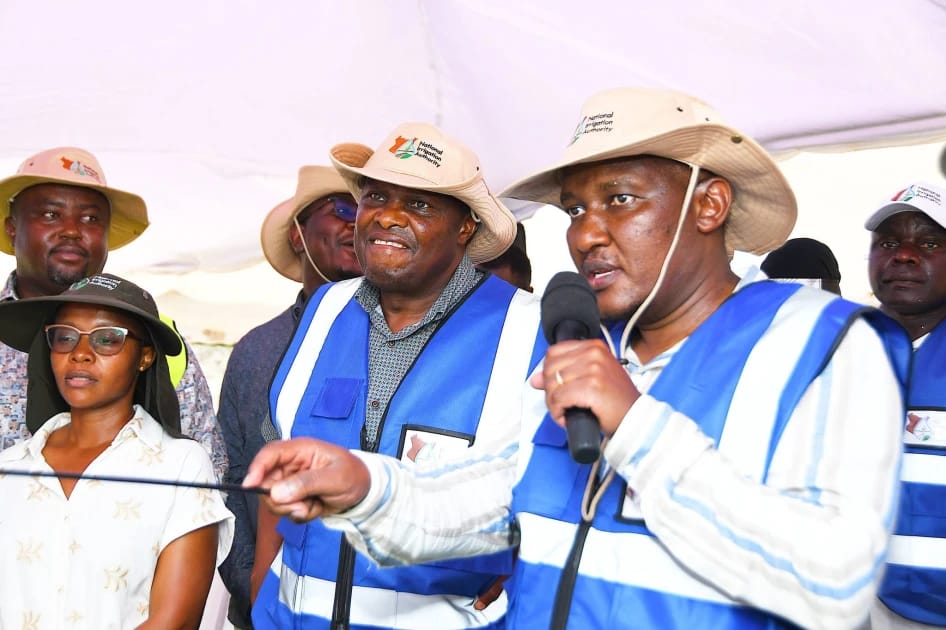
During a visit to Galana-Kulalu, Head of Public Service Felix Koskei, accompanied by 32 Principal Secretaries and other senior government officials, called for investment in critical infrastructure to support large-scale farming. The officials identified reliable electricity, road networks, water storage facilities and agro-processing industries as essential to unlocking the agricultural potential of arid and semi-arid areas.
Livestock Principal Secretary Jonathan Mueke noted that increasing local soya production would help reduce dependence on imported edible oils and animal feed ingredients. He added that it would also lower production costs for livestock farmers.
Special Programmes Principal Secretary Ismail Malim Abdi said expanding irrigation could transform arid and semi-arid regions into productive agricultural zones. These zones, he said, would be capable of supplying food to other parts of the country.
The government is also pursuing additional water storage projects, including the proposed Thwake Dam and plans to construct close to 200 dams to support agricultural activities.
Kenya currently spends an estimated Ksh560 billion annually on food imports. The government hopes to address this by increasing domestic production of essential commodities such as maize, rice, wheat, sugar and edible oils.
The irrigation expansion is expected to create employment opportunities, strengthen agricultural value chains and support local industries through increased agricultural processing.
The government maintains that investing in irrigation infrastructure will be critical in cushioning farmers against climate-related challenges while ensuring a more reliable food supply.
By Lizzy Aluga
Get more stories from our website: Sacco Review.
For comments and clarifications, write to: Saccoreview@
Kindly follow us via our social media pages on Facebook: Sacco Review Newspaper for timely updates
Stay ahead of the pack! Grab the latest Sacco Review newspaper!