- Kajiado is testing sunflower as a new option beyond livestock
- Farmers are being encouraged to explore the crop’s income potential
- Sunflower could also provide a new source of livestock feed
Kajiado is looking beyond livestock, promoting sunflower as a new crop that could boost income, food security and animal feed supply.
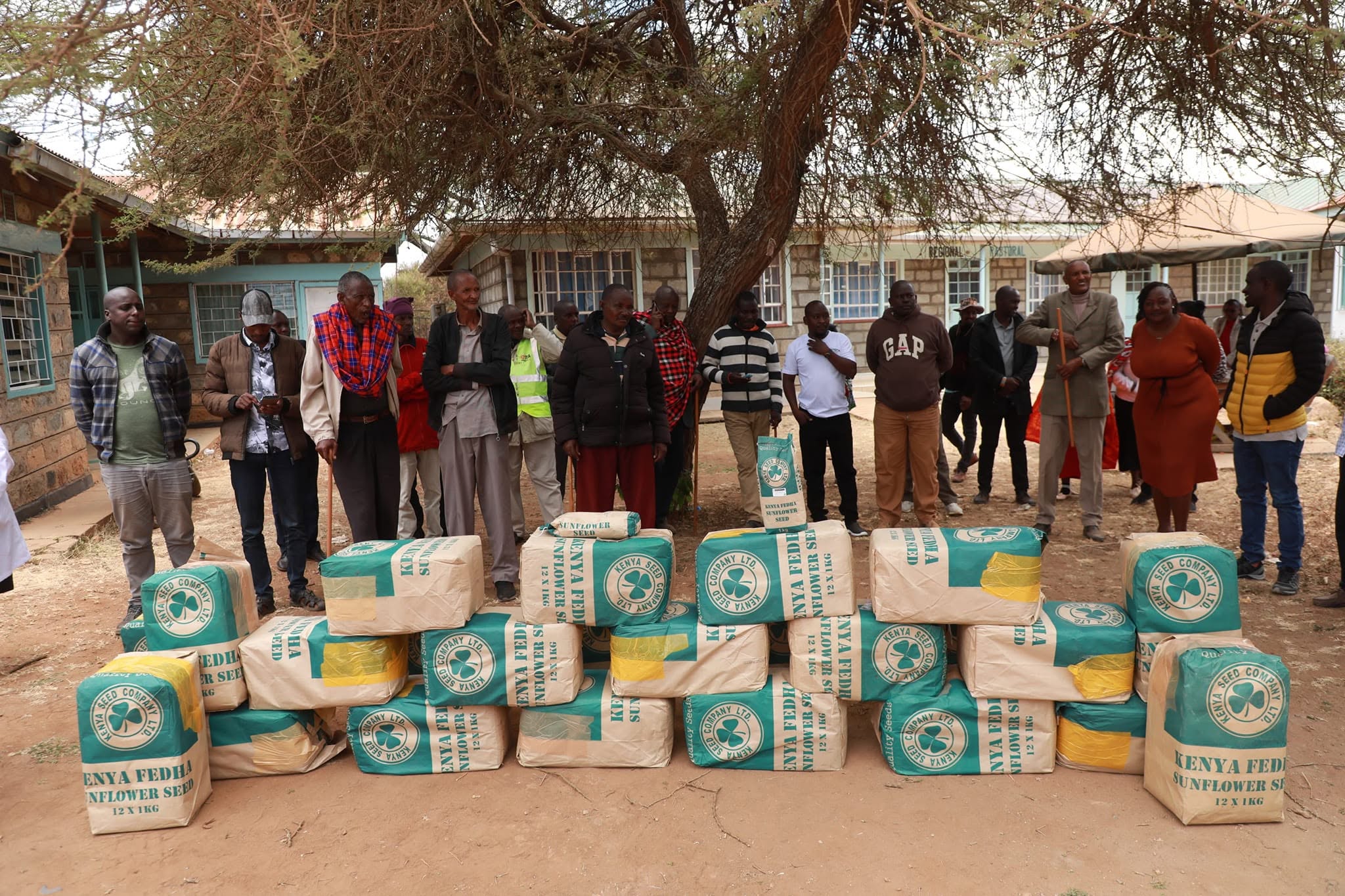
The county has stepped up promotion of oil crops by distributing sunflower seed to farmers in Kajiado Central. County Executive Committee Member (CECM) for Agriculture, Livestock, Irrigation and Fisheries Francis Ole Sakuda led the pilot exercise, saying the county would seek additional seed and other farm inputs to allow more farmers to participate, particularly as favourable rainfall approaches.
While Kajiado’s economy remains livestock based, sunflower offers a short-duration crop that could give households an additional source of food and cash, while also creating raw material for oil processing. Chief Officer for Agriculture and Fisheries Grace Saitoti welcomed the intervention and urged farmers receiving seed to establish demonstration plots, so neighbouring farmers can observe the crop’s performance under local conditions.
Sunflower growing is mainly practised in parts of Kajiado East and Kajiado South. Neighbouring Tanzania has an established sunflower industry that could be replicated in Kajiado.
READ ALSO:
Sunflower remains a relatively small part of Kenya’s agricultural landscape. According to the Agriculture and Food Authority (AFA), national sunflower production stood at about 482 tonnes from 2,045 hectares in 2022, equivalent to roughly 0.24 tonnes per hectare.
Even so, Kajiado’s opportunity lies in building a value chain around the crop. A July 2026 report on sunflower farming in the county found that it scored 92 out of 100 on local soil-suitability models, pointing to considerable agronomic potential where rainfall, soils and farming practices are favourable. Previous production has remained modest, leaving room for expansion if farmers can access reliable seed, extension services, aggregation, markets and processing.
The crop also offers an important connection with livestock. Chief Officer for Livestock Production Francis Metian highlighted the use of sunflower byproducts in livestock feed formulation. Sunflower cake, produced after oil extraction, can serve as a protein-rich feed ingredient, meaning farmers could participate in an oil value chain while retaining a valuable byproduct for animal nutrition.
This crop-livestock link is particularly relevant in Kajiado, where crop farming and pastoral livelihoods increasingly need to coexist. Sunflower provides a practical example of how the two systems can complement each other, with the crop producing oil for human consumption while its residues contribute to livestock feed.
By Benedict Aoya
Get more stories from our website: Sacco Review.
For comments and clarifications, write to: Saccoreview@
Kindly follow us via our social media pages on Facebook: Sacco Review Newspaper for timely updates
Stay ahead of the pack! Grab the latest Sacco Review newspaper!