- Kisumu residents urged to play a bigger role in assessing county governance and service delivery
- NEPAD APRM team returns to validate citizen feedback gathered across the county
- Findings will inform a peer review conference where governors will assess governance gaps and share best practices
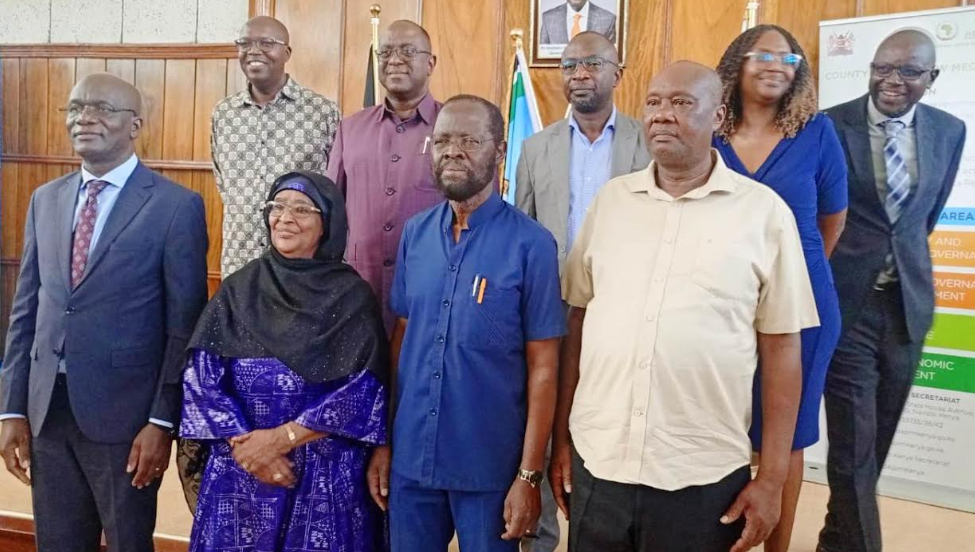
Kisumu Governor Prof. Peter Anyang’ Nyong’o has called for active citizen participation in the New Partnership for Africa’s Development African Peer Review Mechanism (NEPAD-APRM) formative stages.
Nyong’o made the remarks in his office when he received the NEPAD-APRM team in his office and recalled his involvement in the NEPAD initiative since its establishment.
Nyong’o said the validation process was important in strengthening feedback mechanisms in a democratic country such as Kenya, where citizens have a critical role in assessing government performance and influencing development priorities. He said citizen participation was essential in ensuring that governance systems remained responsive to the needs and aspirations of the people.
The governor noted that the NEPAD-APRM team has started the validation of citizen feedback on governance in Kisumu County, with officials saying the exercise will strengthen accountability, improve service delivery and enhance public participation in devolved governance.
The County Peer Review Mechanism (CPRM) has entered its third phase, bringing together stakeholders at the sub-county level to validate findings gathered from citizens during Focus Group Discussions conducted between May and July 2026.
The exercise seeks to establish whether the preliminary assessment accurately reflects citizens’ experiences with the implementation of devolved functions, governance and service delivery at the ward level.
YOU MAY WANT TO READ:
Participants were drawn from diverse groups, including women, youth, boda boda operators, civil society organisations, traders, persons with disabilities, farmers and faith-based organisations.
Former Busia Governor and NEPAD-APRM Secretariat Chairman Sospeter Ojaamong, who spoke during the meeting with the Kisumu governor, said the team had returned to the county to validate information previously collected from members of the public on governance.
“Our team has been here for some time, collecting information from the public, how they feel, how they see they are being governed, and their wishes,” Ojaamong said.
He said the validation process would give citizens an opportunity to confirm whether their views had been captured accurately and provide additional information where necessary. The exercise will be conducted across various sub-counties over a period of one week before the findings are consolidated for further review.
Ojaamong said the findings would subsequently inform a peer review conference in Nairobi, where governors will have an opportunity to assess one another’s governance practices, identify gaps and share best practices.
“They will peer review each other and see, learn from each other the best practices, the gaps that are there, and how best they can come up with the best solutions to govern their subjects,” he said.
Boniface Makokha, a peer reviewer for Economic Planning under the National Treasury, said the County Peer Review Mechanism provides citizens with an opportunity to give constructive feedback to both county and national governments.
Makokha said the feedback would enable governments to better understand the experiences of citizens and use the information to improve planning, budgeting and service delivery.
“One of the things I want to mention is that the County Peer Review Mechanism is a very good initiative that allows Mwananchi to be able to provide feedback to the governors and also the national government. The reason being because once we get the constructive feedback that helps governments to plan well,” Makokha said.
He described CPRM as a noble initiative that promotes government accountability, service delivery and citizen participation. Makokha said the mechanism also supports the government’s Bottom-Up Economic Transformation Agenda by placing citizens at the centre of planning and decision-making.
He disclosed that the county peer review exercise was voluntary, noting that Kisumu County had agreed to participate in the process to allow its governance practices to be assessed and areas requiring improvement identified.
YOU MIGHT HAVE MISSED:
Ambassador Rukia Subow, a panelist reviewing the findings, said the team would seek feedback from Kisumu residents on whether their views had been accurately reflected in the assessment report covering 14 thematic areas.
“We want to hear from the wananchi if their views reflect on the rating report of the governor of Kisumu, which is currently rated at an average of 50 per cent,” Subow said.
She said the validation exercise would provide an important opportunity for citizens to clarify issues raised during the earlier assessment and ensure the final report accurately represented the views of the people.
Once completed, Subow said the team would consolidate the findings into a report to be presented at a peer review conference scheduled for October.
She expressed confidence in public participation, saying residents were increasingly recognising that government resources come from taxpayers and should therefore be scrutinised by citizens.
“The 16 per cent Value Added Tax (VAT), for instance, is the money coming back to them and they need to know if it’s working on health, education, environment, among other thematic areas,” she said.
Subow said greater public awareness and participation would enable citizens to demand accountability and monitor the implementation of government programmes.
The County Peer Review Mechanism is a domesticated application of the African Peer Review Mechanism adopted by African heads of state. It seeks to promote compliance with legal provisions, alignment with Kenya’s Vision 2030, implementation of the Council of Governors’ resolutions on peer reviews and institutionalisation of good governance.
The programme had reviewed 12 counties by the inaugural CPRM Summit held in August 2024, with a projection of 24 counties to be reviewed by 2025.
By Fredrick Odiero
Get more stories from our website: Sacco Review.
For comments and clarifications, write to: Saccoreview@
Kindly follow us via our social media pages on Facebook: Sacco Review Newspaper for timely updates
Stay ahead of the pack! Grab the latest Sacco Review newspaper!