
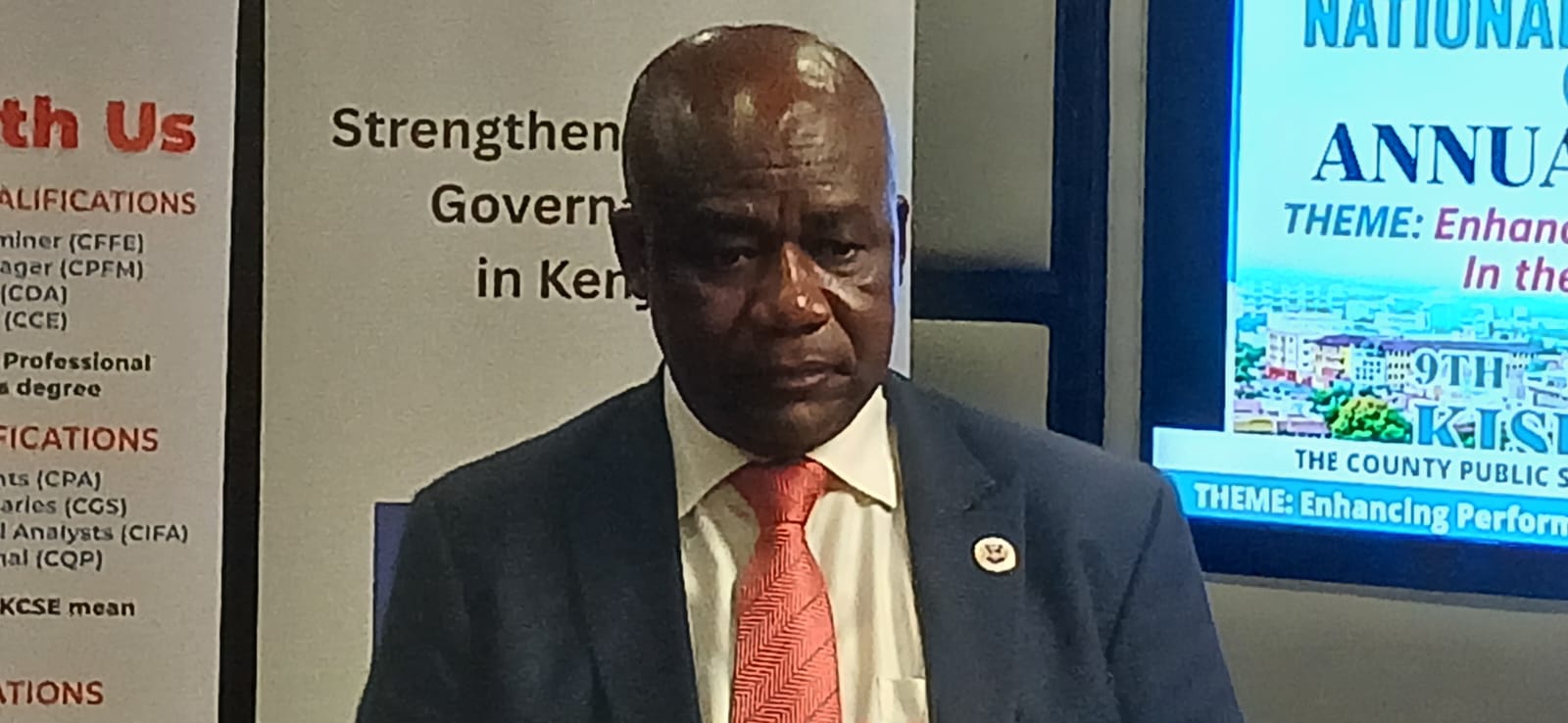
- EACC has raised concerns over weaknesses in government payroll records and verification systems.
- County human resource practices have come under scrutiny over recruitment, promotions and staff accountability.
- The commission has urged county governments to strengthen payroll controls and close loopholes exposing public funds to abuse.
The Ethics and Anti-Corruption Commission (EACC) has revealed that the recent Interim Payroll Audit Report on Kenya’s Human Resource Information System (HRIS-K) raises serious concerns about the management and reliability of government payroll records.
Director for preventive services Vincent Okongo said the audit revealed potential irregular payments of approximately Ksh5.898 billion for the 2024/25 financial year. It also found significant weaknesses in payroll data management, system integration and access controls.
Among the key findings, Okongo said, were missing employee details, invalid Kenya Revenue Authority (KRA) personal identification numbers (PINs), multiple identification numbers, shared bank accounts, and employees recorded as having been posted before their dates of employment.
The audit also identified cases of employees editing their own records. In addition, millions of payroll records had been altered without proper timestamps.
Okongo said this is a significant governance concern. Digitalisation must therefore not be treated merely as an information and communication technology (ICT) modernisation project.
“It is an integrity intervention. County governments must ensure that every employee on the payroll is properly appointed, verified, assigned duties and supported by accurate personnel records,” he said.
He said the developments mean the future of county human resource management must be digital, data-driven, merit-based, performance-oriented and firmly anchored in integrity.
Okongo said the commission also identified weaknesses in the delegation of human resource functions by County Public Service Boards. It has particularly singled out areas where responsibilities have been assigned to departments without formal delegation instruments. Where authority is not clearly defined, he said, accountability becomes difficult to enforce.
Speaking in Kisumu at the national county public service boards consultative forum, Okongo said some county governments operate without approved organisational structures, staff establishments and comprehensive human resource plans.
This, he noted, creates room for irregular recruitment, inappropriate staff deployment, favouritism, understaffing, overstaffing and unsustainable wage bills.
Okongo noted that weaknesses have also been identified in recruitment and the management of casual workers. They include failure to undertake competitive and transparent recruitment, appointment of candidates who do not meet minimum requirements, and prolonged engagement of casual workers without proper regularisation. Others are inadequate employee records and failure to verify academic and professional qualifications. In some instances, he said, background checks have also not been adequately undertaken.
READ ALSO:
The director noted that further gaps have been identified in staff induction and the preparation of job descriptions. Employees sometimes assume office without a clear understanding of their responsibilities, reporting relationships and applicable procedures. This weakens supervision, performance management and accountability.
Okongo pointed out that some county governments have undertaken promotions without fully complying with the applicable Schemes of Service and Human Resource Manuals.
“This creates opportunities for arbitrary decisions, favouritism and discrimination,” he said.
He said weaknesses have also been identified in leave management, particularly where manual systems expose institutions to manipulation of leave records, unauthorised absences and fraudulent leave commutation.
On performance management, he noted, some county governments have yet to fully develop and operationalise effective appraisal systems, performance rewards and sanctions.
“The result is that employees may remain in public service without clear performance targets or meaningful accountability for results,” he said.
Payroll management, Okongo noted, presents another significant area of concern. He said the assessments identified weaknesses such as failure to undertake monthly payroll reconciliations, parallel payroll systems, non-compliance with the one-third salary rule, irregular salary advances, and delays or failure to remit statutory deductions.
The director said the weaknesses expose county governments to payroll fraud, financial losses, penalties and other legal consequences.
He said the commission has further observed gaps in the management of staff discipline and misconduct, including absenteeism, drunkenness, insubordination and absconding from duty.
“Where disciplinary rules are not consistently enforced, a culture of impunity develops,” he noted.
Okongo said some county governments lack effective handover and exit clearance procedures for officers proceeding on leave, transferring or exiting public service. This, he said, exposes public resources, records and institutional operations to loss, misappropriation and disruption.
He said the commission has made recommendations to the respective county governments to address these weaknesses, adding that implementation is at various stages of progress.
Okongo said the County Public Service Boards have a significant role to play in implementing the blueprint and addressing the loopholes identified in human resource management.
By Fredrick Odiero
Get more stories from our website: Sacco Review.
For comments and clarifications, write to: Saccoreview@
Kindly follow us via our social media pages on Facebook: Sacco Review Newspaper for timely updates
Stay ahead of the pack! Grab the latest Sacco Review newspaper!