
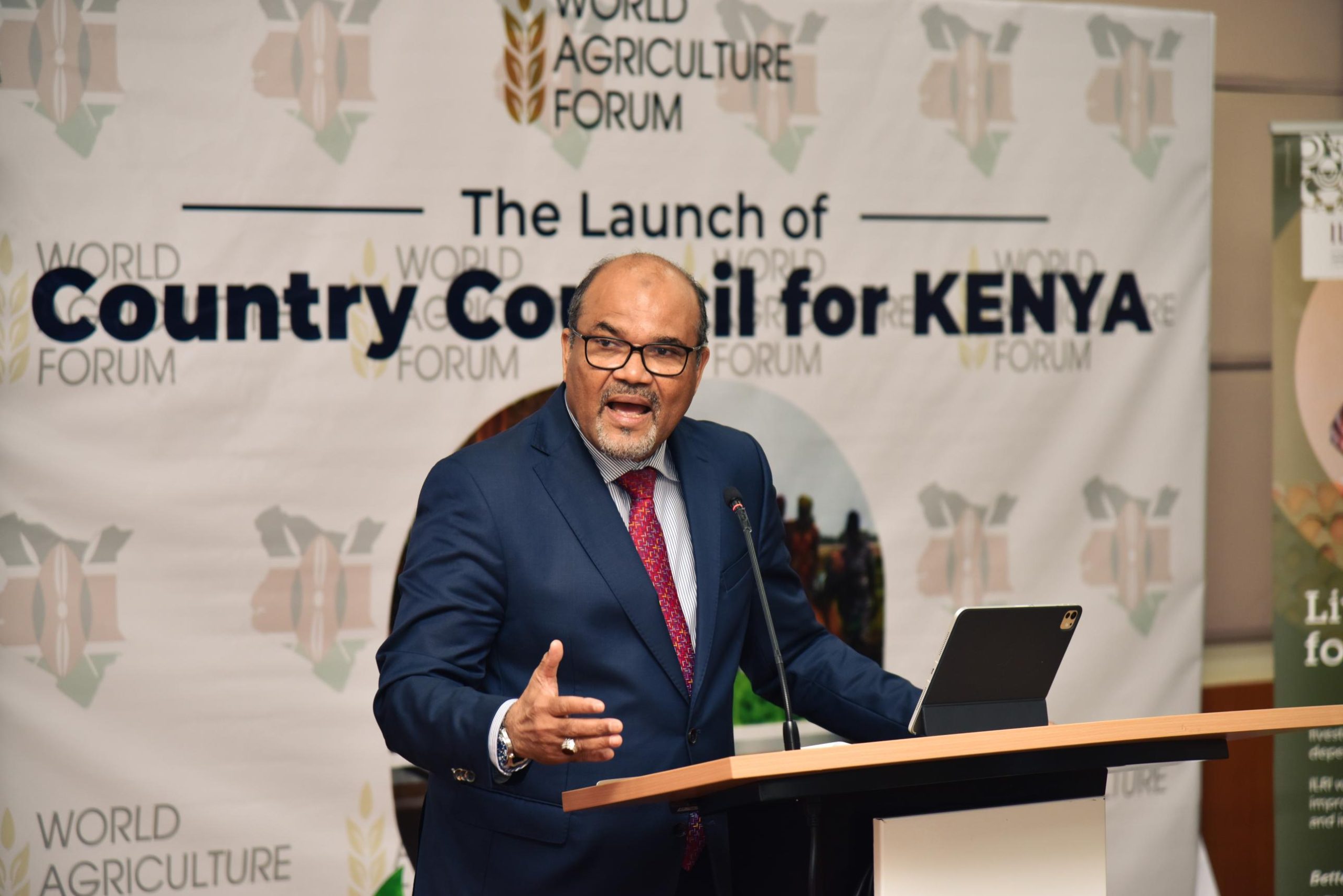
Kenya has unveiled the World Agriculture Forum (WAF) Country Council, a new platform designed to accelerate the transformation of the agriculture sector by linking global innovation to local farming systems.
Speaking at the launch, Science, Research and Innovation Principal Secretary Prof Abdulrazak Shaukat said Kenya must urgently scale both the quality and quantity of agricultural production. He warned that climate change is already disrupting planting seasons, while trade barriers continue to constrain supply chains, even as a rapidly growing population intensifies demand for food.
“These challenges call for innovative, science‑driven solutions that can transform agriculture into a more resilient and productive system,” Shaukat said. He added that the WAF Kenya Country Council will bridge the gap between policy ambition and on‑farm reality by creating integrated investment pipelines that pair digital intelligence with biological innovation.
The PS described Kenya as ready to lead what he termed the “convergence decade,” where artificial intelligence and bioengineering will work hand in hand. “AI can tell a farmer when to plant, but bioengineering gives that farmer the seed that will survive regardless of the season,” he said. The initiative aligns with Kenya’s Bottom‑Up Economic Transformation Agenda (BETA), the AI Strategy 2025–2030, and continental frameworks such as CAADP and Agenda 2063.
ALSO READ:
WAF Global executive director Dr M J Khan said the forum will catalyze shaping the future of food systems worldwide. “Data is the new fertiliser, and through our global councils, we aim to harness it to drive smarter, more resilient agricultural systems,” he said. The platform will operationalise its mission through flagship initiatives, including the Global Soil Health Coalition, Global Digital Agriculture Council, Global Sustainability Council, and the Trade and Food Security Council.
International Livestock Research Institute director general Prof Appolinaire Djikeng welcomed the launch, noting it reflects over a year of collaboration between WAF and ILRI focused on advancing food security, improving agricultural practices, and reducing poverty. “The Kenya Country Council strengthens our shared commitment to translating science and innovation into real impact for farmers,” he said.
Oscar Magenya, WAF Kenya country director, said the council represents a shift from conversation to implementation. “This is not just another council, but a mechanism to turn global best practices into local impact, driving higher productivity, improving farmer incomes, and building a more resilient, technology‑powered food system,” he said.
Industry leaders also shared insights on how digital tools are already transforming farming. Market Farm Ltd chief executive Timothy Wanjohi highlighted the role of AI‑driven advisories, solar‑powered solutions, and digital platforms in reducing post‑harvest losses, improving market access, and increasing profitability. “The opportunity now is to scale these solutions and ensure they reach every farmer who needs them,” he said.
ALSO READ:
Mandera trains lead farmers to boost community agricultural resilience
The WAF Kenya Country Council will focus on building integrated pipelines for agricultural innovation, fostering public‑private partnerships, and engaging county governments as key drivers of implementation. By 2028, the council aims to establish a proven, scalable model that connects global investors to local innovation, accelerates adoption of AI and bioengineering, and strengthens Kenya’s position as a hub for agri‑tech convergence.
The initiative is expected to boost productivity, strengthen climate resilience, and position Kenya as a continental leader in agricultural innovation.
By Masaki Enock
Get more stories from our website: Sacco Review.
For comments and clarifications, write to: Saccoreview@
Kindly follow us via our social media pages on Facebook: Sacco Review Newspaper for timely updates
Stay ahead of the pack! Grab the latest Sacco Review newspaper!