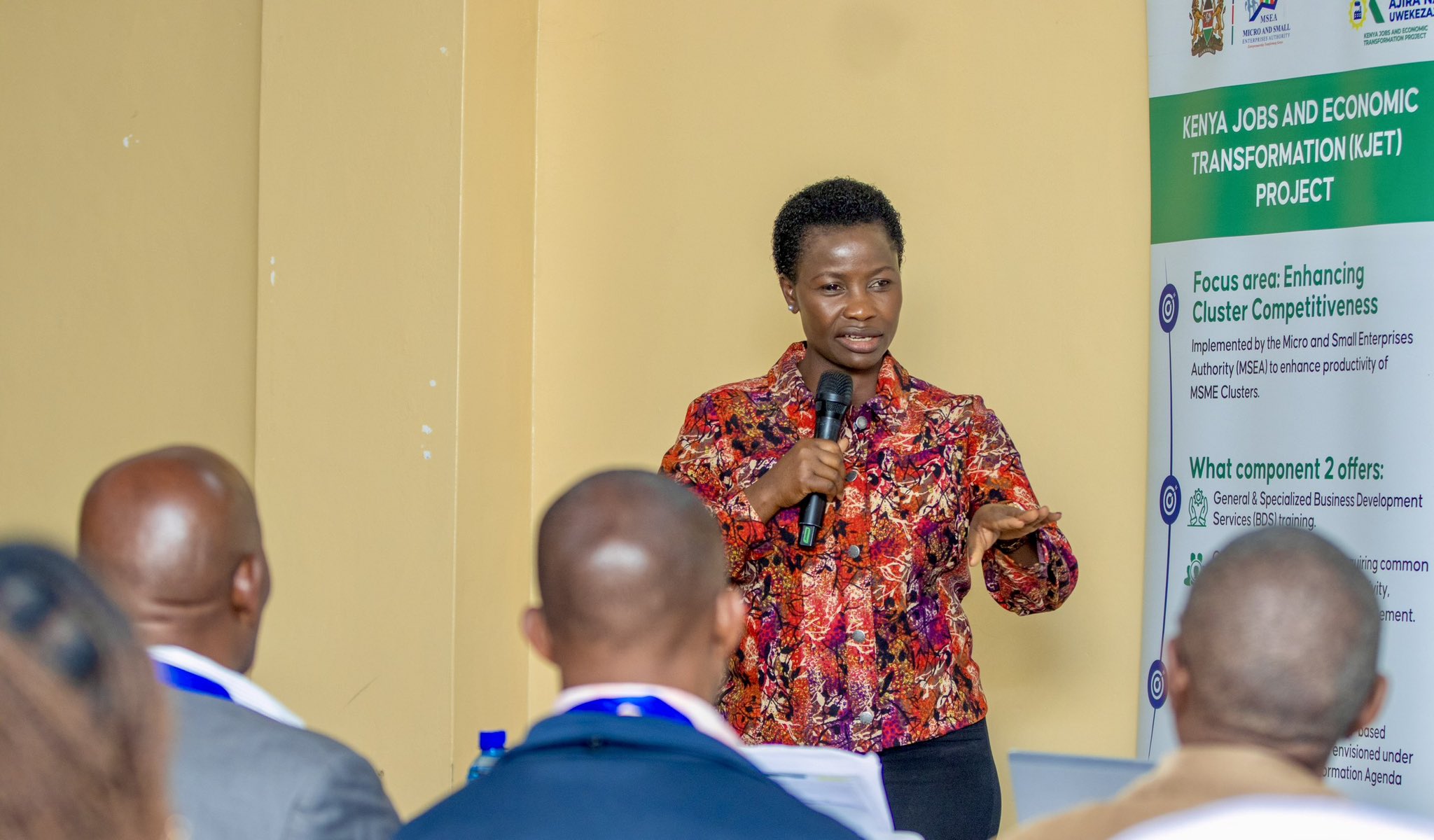
The Micro and Small Enterprises Authority (MSEA) has completed nationwide classroom training for the first cohort of its Business Development Services (BDS) programme, marking a major milestone in efforts to strengthen small businesses under the Kenya Jobs and Economic Transformation (KJET) Project.
The five‑week training, which began on November 10, 2025, reached 94 MSME clusters across all 47 counties, aligning with the government’s Bottom‑up Economic Transformation Agenda (BETA)
The KJET Component 2 programme targets productivity and growth within priority value chains, including edible oils, construction materials, textiles, rice, tea, coffee, dairy, leather, the blue economy and minerals. This initiative aims to boost competitiveness among Micro, Small and Medium Enterprises (MSMEs) operating in these sectors.
Participants underwent a structured 12‑module curriculum designed to equip them with practical business skills, from enterprise management to productivity improvement and market readiness. The sessions featured hands‑on exercises, case studies and group work led by trained facilitators, intending to help MSMEs formalize operations, access new markets and build sustainable growth pathways.
ALSO READ:
Remittances remind us how our government has failed in creating employment
During a monitoring visit in Kiambu and Kajiado counties, Principal Secretary for MSMEs Development Susan Mang’eni said the cluster‑based approach is reshaping how Kenya supports small enterprises.
She noted that many MSMEs struggle to scale because they operate in isolation, limiting their ability to negotiate competitively, adopt new technologies or secure financing.
Mang’eni said the BDS programme is part of a shift toward coordinated, high‑impact interventions that strengthen entire value chains rather than individual businesses. She described the training as a foundation for long‑term competitiveness, job creation and inclusive economic growth under BETA
With the classroom phase now complete, the 94 clusters will transition into a three‑month mentorship period. Each group will receive personalised, in‑person support to help them apply the lessons learned, refine business operations and improve overall performance. MSEA says the mentorship phase is critical for turning theoretical knowledge into measurable results on the ground.
The authority is now inviting cooperatives, associations and cluster‑based MSMEs to apply for Cohort 2 of the BDS programme. Applications close on December 31, 2025, through the KJET portal (https://kjet.msea.go.ke/). The World Bank‑funded project aims to create or improve at least 45,000 jobs, with a strong emphasis on supporting women and youth.
By Felix Wanderi
Get more stories from our website: Sacco Review.
For comments and clarifications, write to: Saccoreview@
Kindly follow us via our social media pages on Facebook: Sacco Review Newspaper for timely updates
Stay ahead of the pack! Grab the latest Sacco Review newspaper!