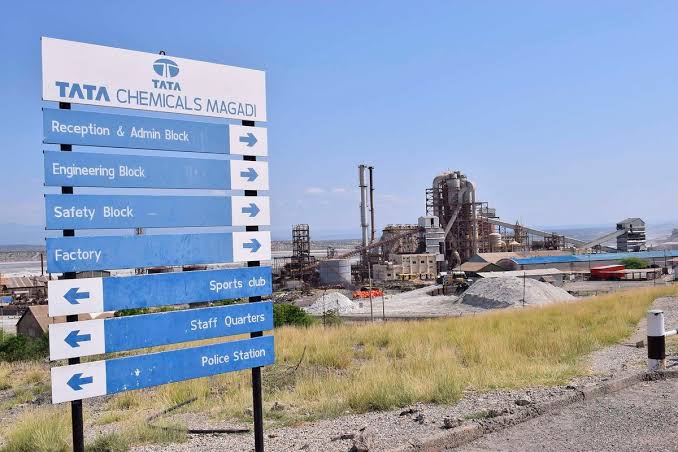
- Ruto’s directive puts over 600 jobs in focus.
- Government wants mining linked to local processing and jobs.
- The new investor will face pressure to deliver broader benefits.
The presidential directive has opened a new chapter in the long-running debate over who truly benefits from Kenya’s mineral wealth — the companies extracting it, the communities living alongside the resources or the country as a whole.
The remarks have put the spotlight not only on Tata’s mining operations but also on the workers whose livelihoods are tied to the company.
The immediate question is whether those workers will retain their jobs if a new operator takes over.
Ruto’s bigger message: No more extraction without industry
Ruto’s announcement was not simply about replacing one mining company with another.
That requirement could fundamentally alter the economic model around Lake Magadi.
Instead of Kenya merely supplying raw materials, the government wants mineral extraction linked to manufacturing, processing, employment and local procurement.
If implemented, the strategy could create jobs beyond the existing workforce by generating demand for technicians, engineers, transporters, suppliers and other businesses.
But the transition also carries a major risk: existing employees could find themselves caught between the end of one investor’s operations and the arrival of another.
Government Had Already Put Tata on Notice
Ruto’s directive did not come out of nowhere.
The July suspension order transformed what had largely been a regulatory dispute into a major confrontation between the government and one of Kenya’s most established mining companies.
Ruto’s latest remarks now take the dispute further — from suspension of operations to an explicit demand for the company’s departure.
What happens to the workers?
For the more than 600 employees, the government’s argument about value addition raises a practical question: will the promised new industrial model protect their livelihoods?
RELATED:
Ruto orders Tata Chemicals Magadi out of Kenya over investment failures
The President has promised more employment opportunities under the new arrangement, but no detailed transition plan has been announced.
A new investor could retain experienced workers, recruit afresh or restructure the workforce around new processing facilities.
The uncertainty could therefore extend beyond Tata’s direct employees.
Mining operations sustain contractors, transport companies, suppliers, small businesses and households whose incomes are connected to the industry.
A change in operator could disrupt that economic ecosystem unless the transition is carefully managed.
The Lake Magadi test
Yet Ruto’s criticism reflects a growing political argument that the length of a company’s presence should not be confused with the scale of its contribution to the host community.
The President wants the next investor to demonstrate that mineral wealth can generate a broader industrial economy within Kajiado.
That means processing locally, employing Kenyans, purchasing locally and ensuring that communities hosting the resources see tangible benefits.
For Kajiado residents, the promise is potentially transformative.
For Tata workers, it is a period of uncertainty.
And for the government, the real test will come after the political declaration: finding an investor capable of replacing a century-old operation, protecting livelihoods and simultaneously delivering the local industrialisation that Ruto has promised.
The fate of more than 600 jobs may therefore become the first measure of whether the government’s Lake Magadi strategy will deliver a genuine economic transformation or simply replace one operator with another.
By Hillary Muhalya
Get more stories from our website: Sacco Review.
For comments and clarifications, write to: Saccoreview@
Kindly follow us via our social media pages on Facebook: Sacco Review Newspaper for timely updates
Stay ahead of the pack! Grab the latest Sacco Review newspaper!