
For decades, Savings and Credit Cooperative Organization (SACCOs) have occupied a special place in Kenya’s financial ecosystem. They are trusted institutions built on community ownership, shared prosperity, and the promise of affordable credit.
Every year, members eagerly await dividend announcements with the same excitement shareholders reserve for listed companies. In many circles, a SACCO that announces a 15 or 20 percent dividend is automatically considered successful, efficient, and financially stable.
But should high dividends really be treated as the ultimate indicator of a SACCO’s financial health?
The answer is more complicated than many members would like to admit.
While strong dividends can reflect healthy profitability and practical management, they can also conceal deeper structural weaknesses. In some cases, SACCOs that consistently promise unusually high returns may actually be exposing themselves to liquidity pressure, weak capital reserves, or unsustainable lending practices. The true measure of financial stability goes far beyond how much money members receive at the end of the year.
A financially stable SACCO is not simply one that pays high dividends. It is one that can withstand economic shocks, maintain adequate liquidity, manage loan defaults effectively, and protect members’ deposits over the long term.
The Sacco Societies Regulatory Authority (SASRA), the body regulating SACCOs in Kenya, has repeatedly emphasized the importance of capital adequacy, liquidity management, and asset quality as the pillars of institutional stability. Studies on deposit-taking SACCOs in Kenya consistently show that non-performing loans, poor liquidity management, and weak capital buffers are among the biggest threats to financial sustainability.
This means that a SACCO can pay attractive dividends today while quietly accumulating risks that may threaten its future survival.
One of the biggest misconceptions among SACCO members is equating profitability with stability. A SACCO may generate strong annual earnings and distribute a large portion of those profits as dividends, but if it fails to retain enough capital for growth and risk absorption, it weakens its own foundation.
Regulators have previously warned that many SACCOs distribute most of their surpluses instead of building institutional capital.
That warning is critical.
ALSO READ:
ACCOSCA pushes reforms to strengthen Africa’s SACCO sector at Southern Bloc Forum
Institutional capital acts as a financial cushion. It protects the SACCO during periods of economic distress, rising loan defaults, or unexpected withdrawals. Without adequate reserves, even a profitable SACCO can become vulnerable during a downturn. In essence, excessively generous dividend payouts may sometimes indicate short-term populism rather than practical financial stewardship.
Recent developments in Kenya’s cooperative sector reinforce this concern. Several SACCOs have reduced dividends in recent years, not necessarily because they are collapsing, but because regulators are encouraging them to strengthen capital adequacy and retain earnings.
Ironically, lower dividends may sometimes signal greater financial discipline.
This is a difficult message for many members to accept. In a competitive market where SACCOs aggressively market dividend rates to attract deposits, management teams often feel pressured to maintain impressive payouts even when broader financial indicators suggest caution. High dividends become a branding tool rather than a reflection of sustainable growth.
The danger is that members may overlook the metrics that truly matter.
For example, loan quality is perhaps one of the clearest indicators of a SACCO’s financial health. If a significant percentage of members are failing to repay loans, the institution’s income stream becomes unstable. Rising non-performing loans reduce profitability and strain liquidity. Studies on Kenyan SACCOs have established a direct relationship between bad loans and financial instability.
Yet many members rarely ask about a SACCO’s non-performing loan ratio during annual general meetings. Instead, discussions focus almost entirely on dividends.
Liquidity is another overlooked factor. A financially stable SACCO must maintain enough cash or liquid assets to meet members’ withdrawal demands and loan obligations. Some SACCOs may pay high dividends while struggling to process withdrawals promptly. This contradiction should immediately raise concern among members.
Across online forums and public discussions, some SACCO members have complained about delayed exits, withdrawal restrictions, or operational inefficiencies despite attractive dividend announcements. Others question how certain SACCOs sustain unusually high returns year after year.
Such concerns do not necessarily mean SACCOs are failing. However, they highlight the importance of looking beyond headline dividend figures.
Governance also matters immensely. A SACCO with transparent leadership, audited financial statements, strong internal controls, and ethical management practices is more likely to remain stable in the long term than one driven by aggressive dividend marketing.
Kenya’s cooperative movement has occasionally suffered from governance scandals, mismanagement, and weak oversight. In those situations, high dividends can become a dangerous illusion that masks underlying inefficiencies or reckless practices.
Members therefore need to shift their mindset from “Which SACCO pays the highest dividends?” to “Which SACCO is financially sustainable?”
That shift requires financial literacy.
ALSO READ:
CS Kagwe orders crackdown on milk hawking to safeguard consumers and strengthen dairy Sector
A prudent member should examine several indicators before concluding that a SACCO is stable. These include capital adequacy ratios, liquidity ratios, asset quality, loan recovery performance, operational efficiency, and governance standards.
SASRA guidelines recommend minimum thresholds for core capital and institutional capital precisely because these indicators determine whether a SACCO can survive economic pressure.
In many ways, SACCOs face the same balancing act as commercial banks. They must reward members while simultaneously protecting institutional sustainability. A SACCO that retains earnings to strengthen reserves may appear less attractive in the short term, but it may ultimately prove more resilient and trustworthy over time.
This is especially important in an uncertain economic environment marked by inflation, rising defaults, and shifting regulatory requirements. Financial institutions that prioritize stability over flashy returns are often better positioned to endure crises.
None of this suggests that dividends are unimportant. On the contrary, dividends remain one of the key benefits of SACCO membership. Strong and consistent returns can indicate efficient operations, healthy profitability, and effective investment strategies. Members naturally expect value from their savings and shares.
However, dividends should be treated as one indicator among many — not the sole measure of success.
A SACCO paying moderate but sustainable dividends while maintaining strong reserves, healthy liquidity, and low loan defaults may actually be safer than one offering exceptionally high payouts at the expense of long-term stability.
Ultimately, the real question is not how much dividend your SACCO pays this year. The more important question is whether your SACCO will still be financially strong ten years from now.
In the cooperative movement, sustainability matters more than spectacle. High dividends may attract attention, but financial stability is what protects members’ futures.
By Juma Ndigo
Get more stories from our website: Sacco Review.
For comments and clarifications, write to: Saccoreview@
Kindly follow us via our social media pages on Facebook: Sacco Review Newspaper for timely updates
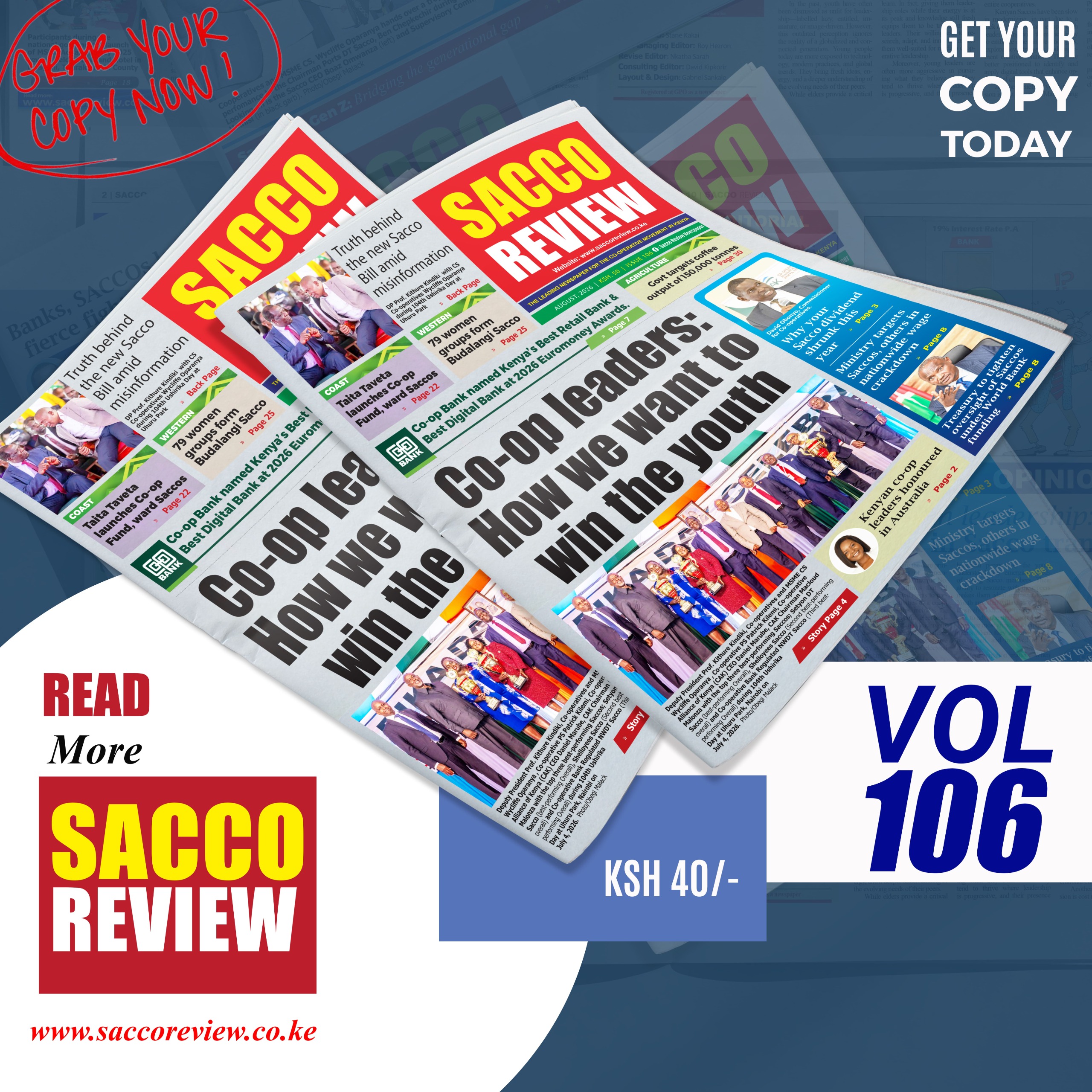
Stay ahead of the pack! Grab the latest Sacco Review newspaper!