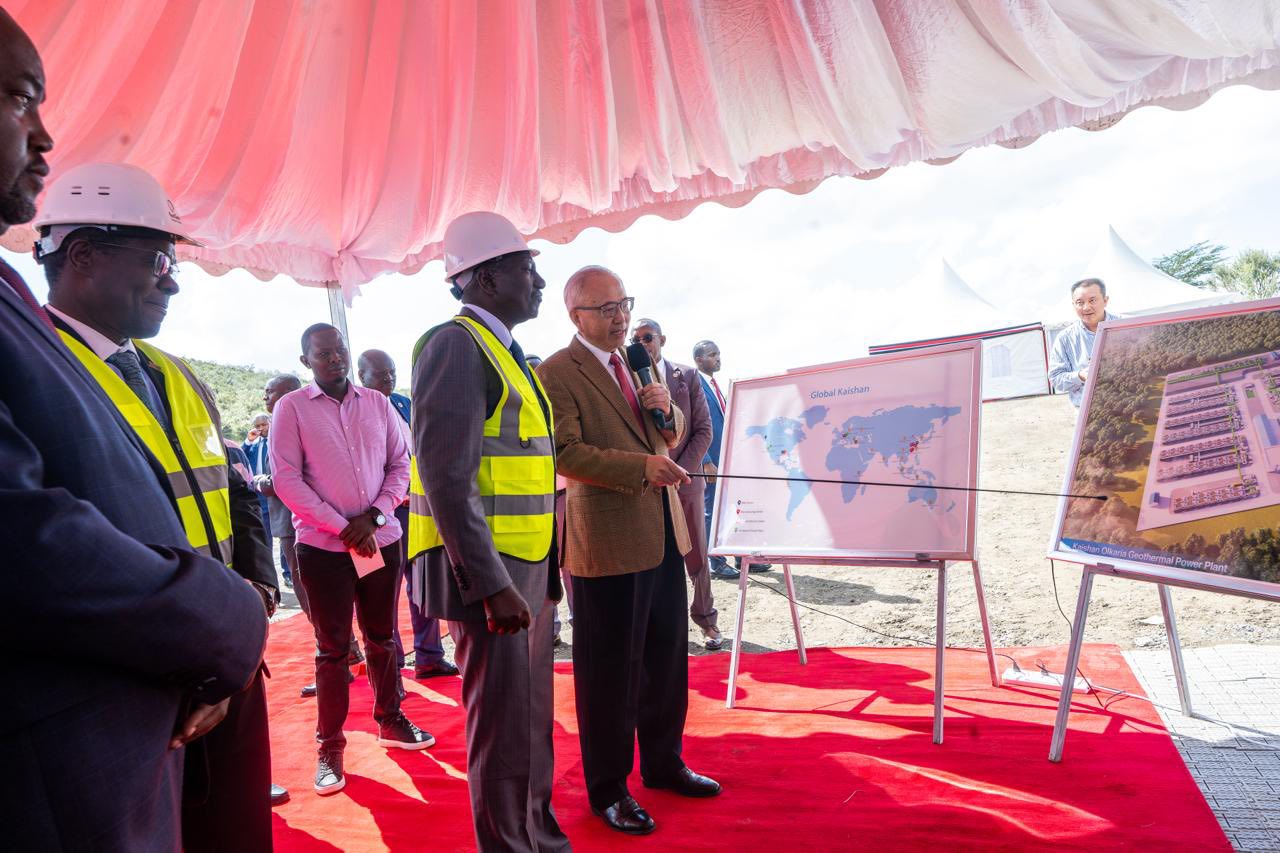
President William Ruto has officially launched the KenGen–Kaishan Green Ammonia Fertiliser Project in Olkaria, Nakuru County, marking a significant step towards boosting Kenya’s agricultural self-sufficiency and reducing reliance on fertiliser imports.
Speaking at the groundbreaking ceremony on Monday, President Ruto emphasized that the project is a testament to Kenya’s ambition to combine renewable energy, innovation, and industrial growth to transform its economy.
The new fertiliser plant, once operational, is expected to produce up to 480,000 tonnes of fertiliser annually, providing local farmers with a steady, affordable supply while protecting the country from volatile global fertiliser prices. The president pointed out that in 2023 alone, Kenya imported over 600,000 tonnes of fertiliser, with a further 443,000 tonnes worth nearly Sh60 billion imported in the first half of 2025. He noted that each import represents a financial drain on the Treasury and an opportunity lost for local production.
“This project marks a major milestone in our journey toward self-sufficiency in fertiliser production,” said President Ruto. “By reducing our dependence on imports, we are creating a resilient, sustainable agricultural sector.”
The KenGen–Kaishan Green Ammonia Fertiliser Project will utilize 165MW of geothermal energy to produce green ammonia, which will then be converted into fertiliser. This makes the plant the first of its kind in Africa, utilizing Kenya’s abundant geothermal resources. With an estimated 10,000MW of geothermal potential, the country has so far harnessed only 1,000MW of this resource.
In addition to bolstering Kenya’s fertiliser production capacity, the project is expected to help mitigate climate change by reducing carbon emissions. It will cut over 600,000 tonnes of CO2 annually, which is the equivalent of removing 130,000 petrol and diesel vehicles from the roads.
ALSO READ:
Taita Taveta registers 27 new cooperatives in abid to expand county development
The project, which comes with an investment of $800 million(Ksh100 billion), is also expected to create over 2,000 jobs and train a new generation of experts in geothermal energy, hydrogen technologies, and industrial processes. Furthermore, it is anticipated to generate approximately $13 million (Ksh1.7 billion) in annual profits for KenGen, with opportunities for additional revenue through carbon credit trading.
President Ruto stressed that the green fertiliser produced in Kenya will offer a competitive advantage for the country’s exports on the global market and cement Kenya’s leadership in sustainable innovation. He also outlined the government’s broader energy and infrastructure agenda, including plans to increase the nation’s energy capacity from the current 2,300MW to 10,000MW over the next decade in order to meet the demands of industrialization and economic growth.
In addition to expanding energy capacity, Ruto highlighted ongoing initiatives to build 50 new mega dams, aimed at irrigating 2.5 million acres of land and cutting the country’s annual food import bill, which currently stands at KSh500 billion. The president also shared plans to dual 1,000 kilometers of highways and tarmac 10,000 kilometers of rural roads.
The KenGen–Kaishan Green Ammonia Fertiliser Project represents a pivotal moment in Kenya’s quest for agricultural sustainability, economic resilience, and green industrial development.
By Obegi Malack
Get more stories from our website: Sacco Review.
For comments and clarifications, write to: Saccoreview@
Kindly follow us via our social media pages on Facebook: Sacco Review Newspaper for timely updates
Stay ahead of the pack! Grab the latest Sacco Review newspaper!