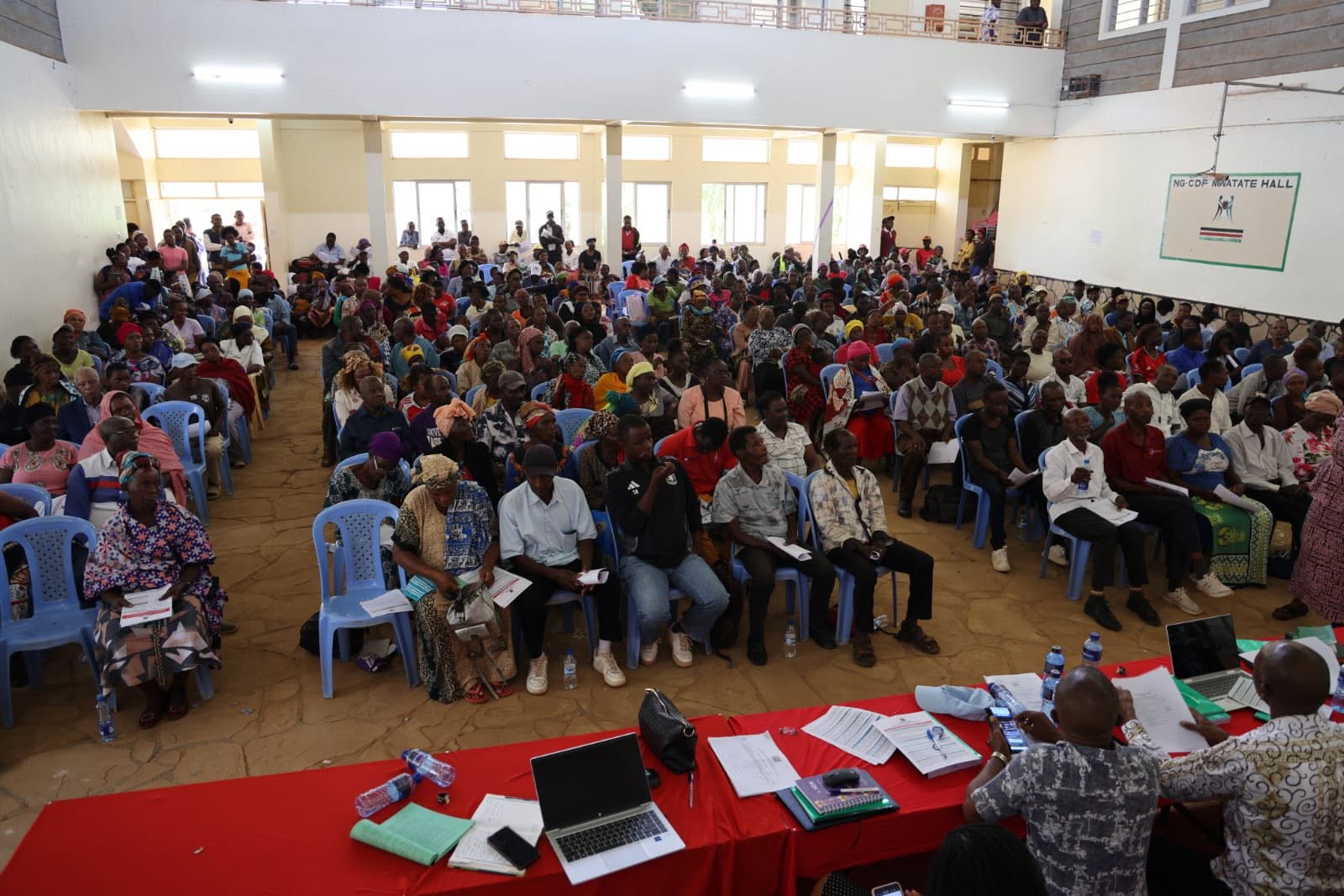
Residents of Taita Taveta County have called on the National Assembly to scale down proposed taxes on digital transactions and mobile phones, warning that the Finance Bill, 2026, could stifle innovation, entrepreneurship, and youth employment in the digital economy.
Led by representatives from the National Youth Council (NYC) Taita Taveta chapter, the residents who were attending a public participation forum on the Bill and three other legislative pieces told the National Assembly’s Departmental Committee on Finance and National Planning that the new tax measures threaten to cripple innovation, agribusiness, and employment.
In a petition, signed and submitted to the MPs by County Youth Leader Winstone Changulo, highlighted their deep concerns over the escalating costs of digital participation.
Among the residents’ key concerns was Clause 31(b), which seeks to impose Value-Added Tax (VAT) on digital payment services.
The youth leader argued that penalizing mobile money transfers will directly erode the razor-thin profit margins of freelancers, e-commerce operators, and micro-enterprises that rely entirely on financial inclusion tools.
“Revenue measures should expand opportunities for young people rather than increase barriers to participation in the economy,” he remarked, urging the National Assembly to look towards progressive growth rather than aggressive taxation.
Further, forum participants took aim at Clauses 34 and 35, which seek to introduce excise duty on mobile phones at the point of activation.
In the session chaired by Julius Rutto, residents observed that the provision lacks clarity on how the Kenya Revenue Authority (KRA) will verify whether taxes were paid prior to a phone’s activation.
ALSO READ:
Livestock outpaces other agricultural sectors in global growth: FAO study
“How will KRA determine how much has been paid on a phone that is already on sale at a mobile shop when a new owner purchases it and wishes to activate it? There is a need to clarify what the point of activation refers to, Margaret Wakio from Voi submitted.
The residents also emphasized that continued taxation on phones will stifle innovation, as smartphones, which most youth use to generate content as a means of livelihood, will become out of reach, driving many young people out of an income.
Youth leader Abubakar Khalfam urged the lawmakers to consider exempting low-cost phones from taxation entirely.
“We urge the Committee to consider reducing the proposed 25 per cent tax on phones to 10 per cent, and if not, exempt phones whose value is less than Ksh 15,000 from taxation”, Abubakar appealed.
Beyond the digital sphere, their pushback extended deeply into the region’s core economic drivers, specifically advocating for relief in agriculture and broader revenue fairness.
“High production costs have long discouraged youth involvement in farming. We therefore propose a revision of value added tax on agricultural inputs from 16 per cent down to 8 per cent”, John Mjomba from Mwatate told the Members.
Weighing in on the debate, Youth Lead Africa’s Duncan Moses Wangama underscored the need to address the shrinking pool of disposable income. Urging the Committee to listen to the voice of the youth, Wangama cautioned that the government risks alienating and penalizing 75 per cent of Kenya’s population if youth voices are ignored.
He highlighted a mix of relief and growing anxiety regarding the proposed economic reforms through the Finance Bill.
ALSO READ:
How SACCOs have become the unsung heroes of teachers’ financial survival stories
While welcoming specific adjustments such as lowering mobile phone taxes from 55 per cent, granting VAT exemptions for local Public-Private Partnership (PPP) infrastructure, and increasing tax-free diaspora allowances, Wangama argued that some punitive provisions in the Bill drastically outweigh the benefits.
He cited the new tax provisions aimed at digital spaces and the informal economy. According to Wangama, these proposals, if adopted, will directly penalize tech-savvy young entrepreneurs and disproportionately exploit low-income earners who rely heavily on mobile money.
Additionally, residents pushed back against the proposal to shorten the six-month tax filing window to four months, as well as the proposed 20 per cent withholding tax on gambling winnings, cautioning that the move would cripple micro-enterprises and alternative youth income streams.
Their views also expanded to the Sovereign Wealth Fund Bill, 2026.
Although Youths Lead Africa supported the Bill’s foundational clauses to save oil and mineral revenues for future generations under strict anti-corruption guardrails, they expressed concern over the structure of its leadership.
“The current structure features zero youth seats on the oversight board, leaning entirely on cabinet officials and financial experts”, they told the Committee.
“If this fund is for future generations, then future generations must be represented in managing it”, they added.
They also took issue with the sweeping powers granted to the Cabinet Secretary for the National Treasury and called for an expanded role for Parliament in the operations of the Fund.
Additionally, they advocated for localized youth-hiring quotas for Sovereign Wealth Fund-backed infrastructure projects, once established.
ALSO READ:
Isiolo hosts sixth MSME Connect forum to boost small business growth
Meanwhile, the county residents called for the revision of the Mining Act and the Petroleum Act to increase the local community’s revenue share from the proceeds of minerals and petroleum.
They noted that the current provision granting the community a 10 per cent share was far too small to realize any tangible benefits.
Responding to these concerns, Committee Members Chiforomodo Mwangale and(Dr.) Shadrack Mwiti noted that the Sovereign Wealth Fund Bill, if enacted, would greatly assist the county, which is endowed with rich mineral deposits.
“This law is a game changer for the youth of this country because it is intended to safeguard their future. When minerals such as the ones this county is endowed with are depleted, proceeds derived from such minerals will generate an alternative stream of income to support expenditure on capital projects and to distribute wealth across generations”, Mwiti noted.
Under Kenya’s Mining Act of 2016 (Section 183), mineral royalties are distributed using a structured three-tier sharing formula, with 70 per cent going to the National Government, 20 per cent to county governments, and 10 per cent to the local community.
This framework is designed to balance national economic interests while ensuring that county governments and local communities directly benefit from the extraction of their natural resources.
In their concluding remarks, Mwangale and Rutto assured the residents that their views would be fully taken into account when the Committee retreats to write its report.
By Juma Ndigo
Get more stories from our website: Sacco Review.
For comments and clarifications, write to: Saccoreview@
Kindly follow us via our social media pages on Facebook: Sacco Review Newspaper for timely updates
Stay ahead of the pack! Grab the latest Sacco Review newspaper!