- Mitumba remains a lifeline for affordable fashion and millions of livelihoods in Kenya.
- Rebuilding local textile manufacturing requires tackling high costs, weak supply chains and limited financing.
- Experts favour coexistence rather than a ban, with Kenyan products competing through quality, price and design.
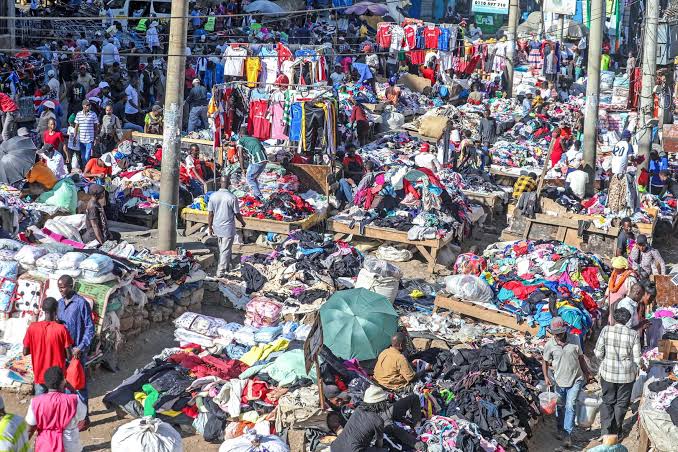
Walk into almost any Kenyan home, and you will likely find at least one piece of mitumba. It could be a jacket, jeans, a dress or shoes bought because they offered better value than new alternatives.
For millions of Kenyans, mitumba is no longer just second-hand clothing; it is fashion, affordability, employment and, for many households, a necessity.
Behind every bale opened in a Kenyan market lies a remarkable international journey involving donations, traders, sorting centres, shippers and retailers.
This same industry has also fuelled one of Kenya’s longest-running economic debates: did mitumba weaken the country’s textile industry, and how can Kenya rebuild it without hurting affordable clothing or the livelihoods it supports?
A global supply chain, not just donations
Kenya’s mitumba comes from countries including China, the US, Pakistan, the UK, Germany and Canada, with China the largest recorded source by volume. However, the shipping country isn’t necessarily where a garment was originally worn.
READ:
Kenya exports premium rice as imports fill widening supply gap
Many items start as donations, get sorted, and eventually enter commercial export markets. By the time a shirt reaches Nairobi’s Gikomba market or towns like Eldoret and Kisumu, it has passed through an international trading system, not a direct charitable gift.
Understanding grades and health risks
Traders sort bales using labels like Grade A or premium, but this reflects perceived quality, not government health certification. Researchers have warned that used textiles can harbour bacteria such as E. coli and Klebsiella.
Still, presence of microorganisms doesn’t automatically mean illness will follow; the real risk depends on exposure and contamination levels. Therefore, the sensible advice remains simple: inspect, wash and dry mitumba thoroughly before wearing it, with extra caution for underwear and swimwear.
Why Kenyans prefer mitumba
Beyond affordability, many Kenyans believe mitumba offers better durability and variety than cheap new alternatives, while also providing access to international brands.
For young people especially, it has become a fashion market rather than merely a poverty market. Consequently, telling Kenyans to simply “buy local” won’t shift behaviour unless local products can compete.
What happened to textile jobs?
Kenya’s textile sector once employed over 200,000 workers directly in the 1980s, a figure far higher than today. However, mitumba wasn’t the sole cause of decline; outdated machinery, high costs and policy failures also played a role.
READ ALSO:
Taita Taveta banana farmers set to benefit from Sh8.6m grant
Meanwhile, the second-hand trade created an estimated two million livelihoods across importing, transport and retail. The real question, then, isn’t how many jobs mitumba destroyed, but how Kenya can preserve mitumba-driven livelihoods while rebuilding manufacturing capacity.
The path forward
To compete, local manufacturers need affordable electricity, efficient logistics, accessible credit and a stronger cotton-to-clothing value chain, from farming to fabric to finished garments.
Government procurement, including uniforms for schools, hospitals and security agencies, could create predictable demand for Kenyan-made products.
The leather and footwear sector holds similar potential, given Kenya’s livestock resources, provided tanneries and shoemakers gain better inputs and market access.
Importantly, quality alone isn’t enough. Kenyan brands must also deliver design and identity that resonates with consumers, supported by fashion incubators, trade fairs and export promotion.
Coexistence, not elimination
A sudden mitumba ban would hurt consumers and traders without fixing manufacturing weaknesses. Instead, industry voices increasingly argue for coexistence, allowing affordable second-hand clothing alongside a growing local industry.
The ultimate goal is for Kenyan-made products to win consumers on merit, offering comparable quality, competitive pricing and reliable availability.
Ultimately, the jacket hanging in a Kenyan wardrobe tells a bigger story: about global trade, local livelihoods, and the kind of economy Kenya wants to build.
The smarter ambition isn’t choosing between mitumba and local manufacturing; it’s building an economy where both can thrive, until Kenyan-made clothing becomes a choice consumers make voluntarily.
By Hillary Muhalya
Get more stories from our website: Sacco Review.
For comments and clarifications, write to: Saccoreview@
Kindly follow us via our social media pages on Facebook: Sacco Review Newspaper for timely updates
Stay ahead of the pack! Grab the latest Sacco Review newspaper!